
AI Control Plane: The System of Trust for the Agentic Workforce











See Every Action, Control Every Outcome
Agents are first-class enterprise actors, making autonomous decisions across your operations. Agents aren’t just sending data out. They’re pulling it in through MCP servers, WebFetch calls, and tool endpoints that can return PII, PHI, or secrets directly into agent context. That inbound vector is the one existing security tooling wasn’t designed for. By the time the data is in the agent’s context, it’s already too late to stop it from landing in a prompt, a response, or committed code.
Most enterprises don’t fully know what they’re accessing, what they’re spending, or what sensitive data has moved through them.
That’s not a coding agent problem. That’s an enforcement and observability problem.
Visibility, Context, and Control for AI Agents
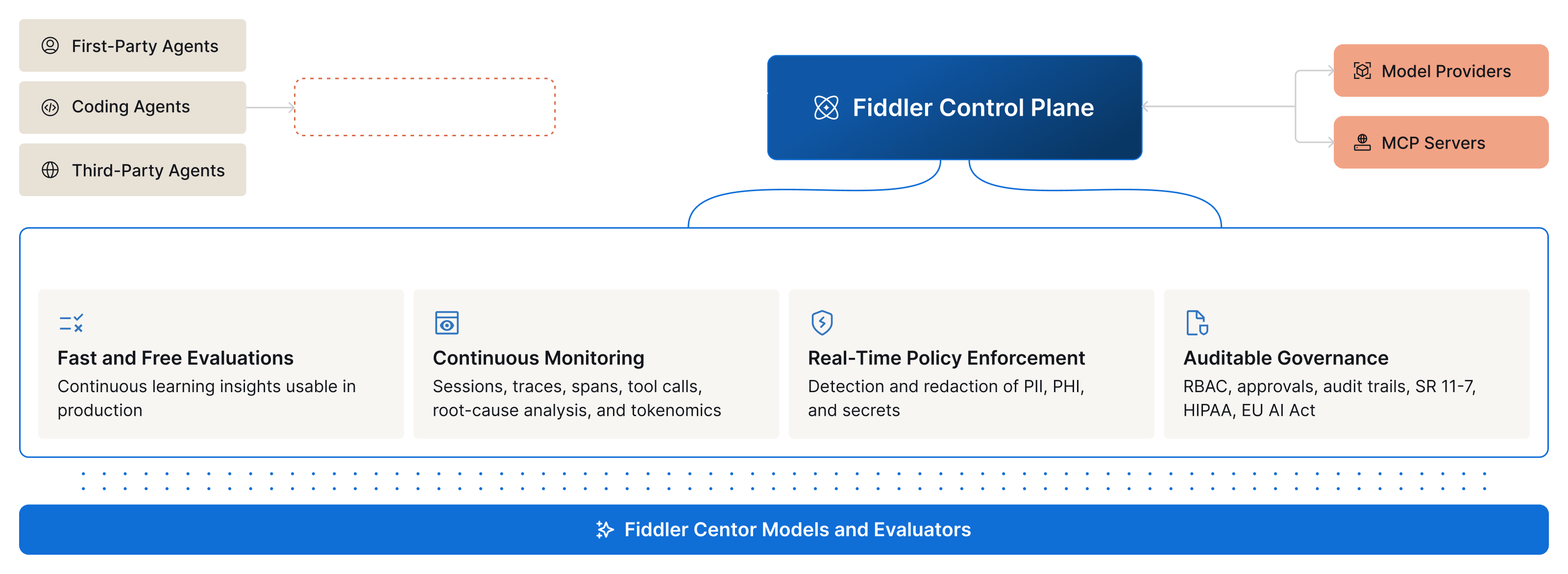
One System for the Agentic Lifecycle
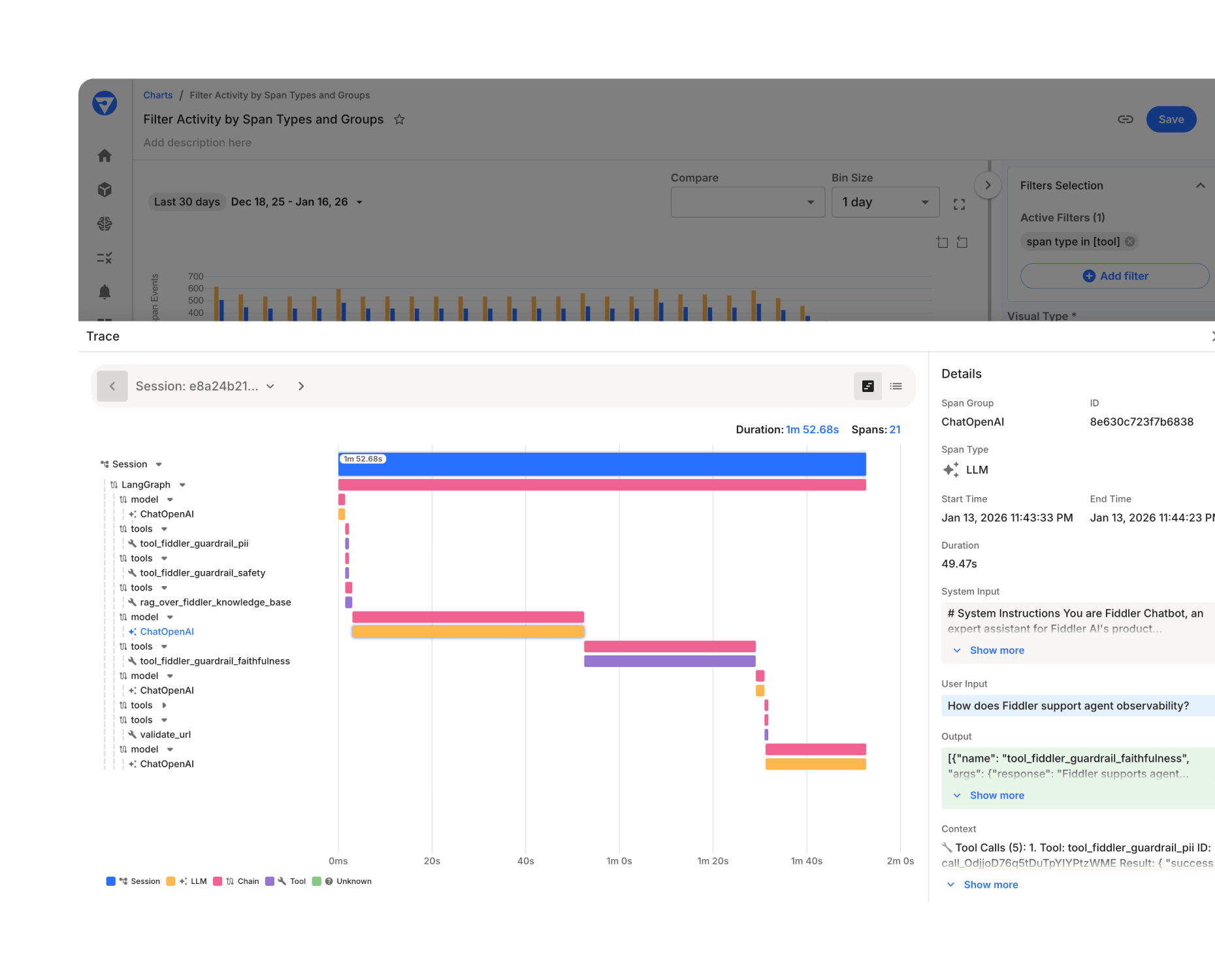
Evaluation and Monitoring Across the Agent Lifecycle
Agent trust requires continuous validation, not point-in-time checks. Fiddler evaluates agents from pre-launch testing through production, with agentic observability across every session, span, and tool call. Surface exactly how agents behave, where they fail, and what they cost, with root-cause diagnostics and real-time alerts.
- Test agents against golden and challenger datasets before any deployment.
- Trace complete execution paths, from application to session to agent to span, to surface agent reasoning, tool calls, and decision points.
- Detect failures, regressions, emerging risks, and costly retry loops with real-time alerts and diagnostics.
- Native OpenTelemetry support. No SDK or instrumentation needed.
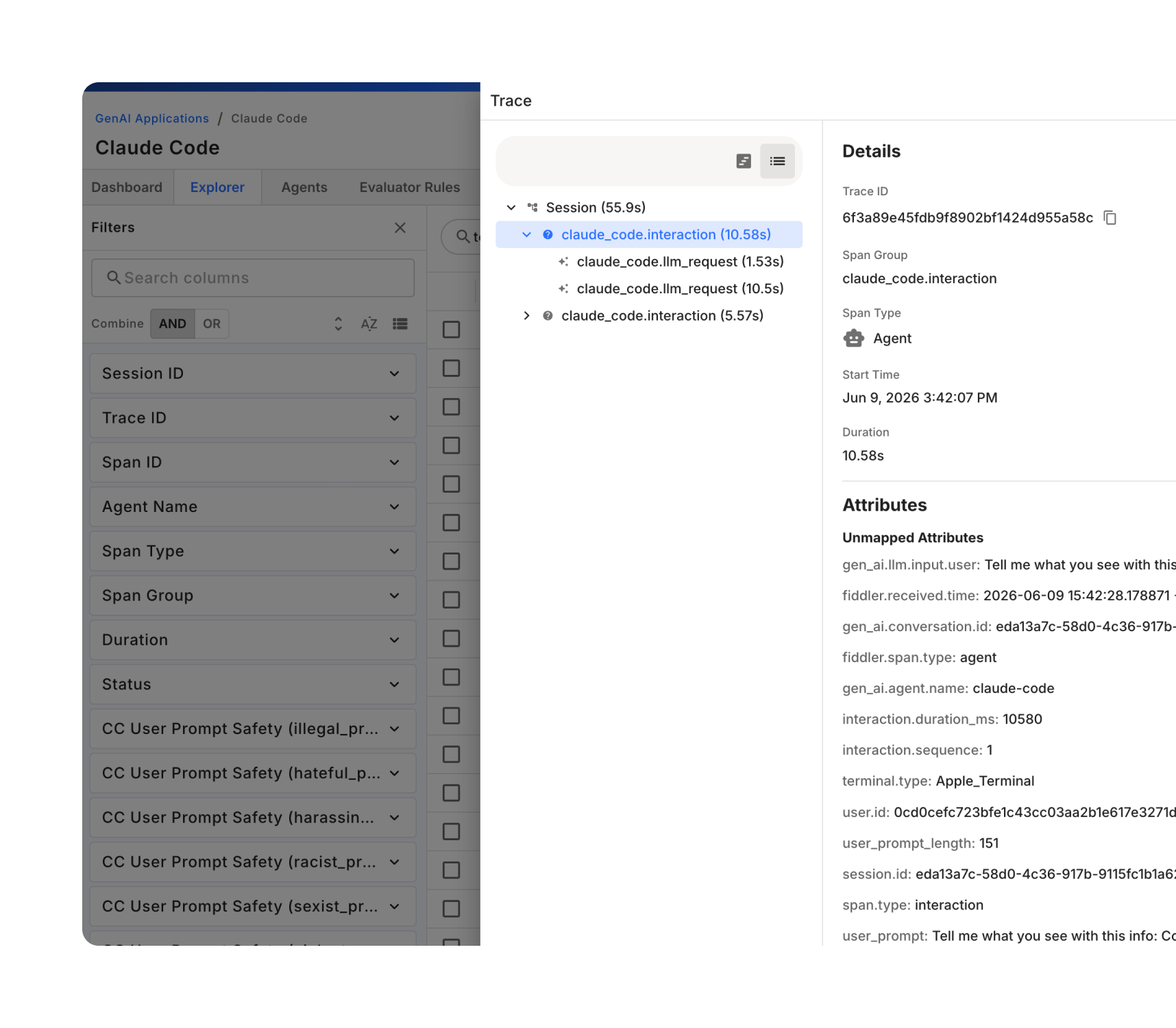
Inline Enforcement at Every Request and Response
Turn policy into guardrails at the gateway you already run, enforced in both directions before data reaches the model or gets committed to code. Enforcement extends to the IDE, CLI, and MCP boundary, with human approval required for high-risk decisions. Detect and redact PII/PHI and secrets at every point of contact:
- In an agent's prompt or request, before it reaches the model, so the model only processes approved input.
- In a tool or endpoint response, before it enters context, so the agent only acts on permitted output.
- In keys, .env files, and tokens, before they go anywhere.
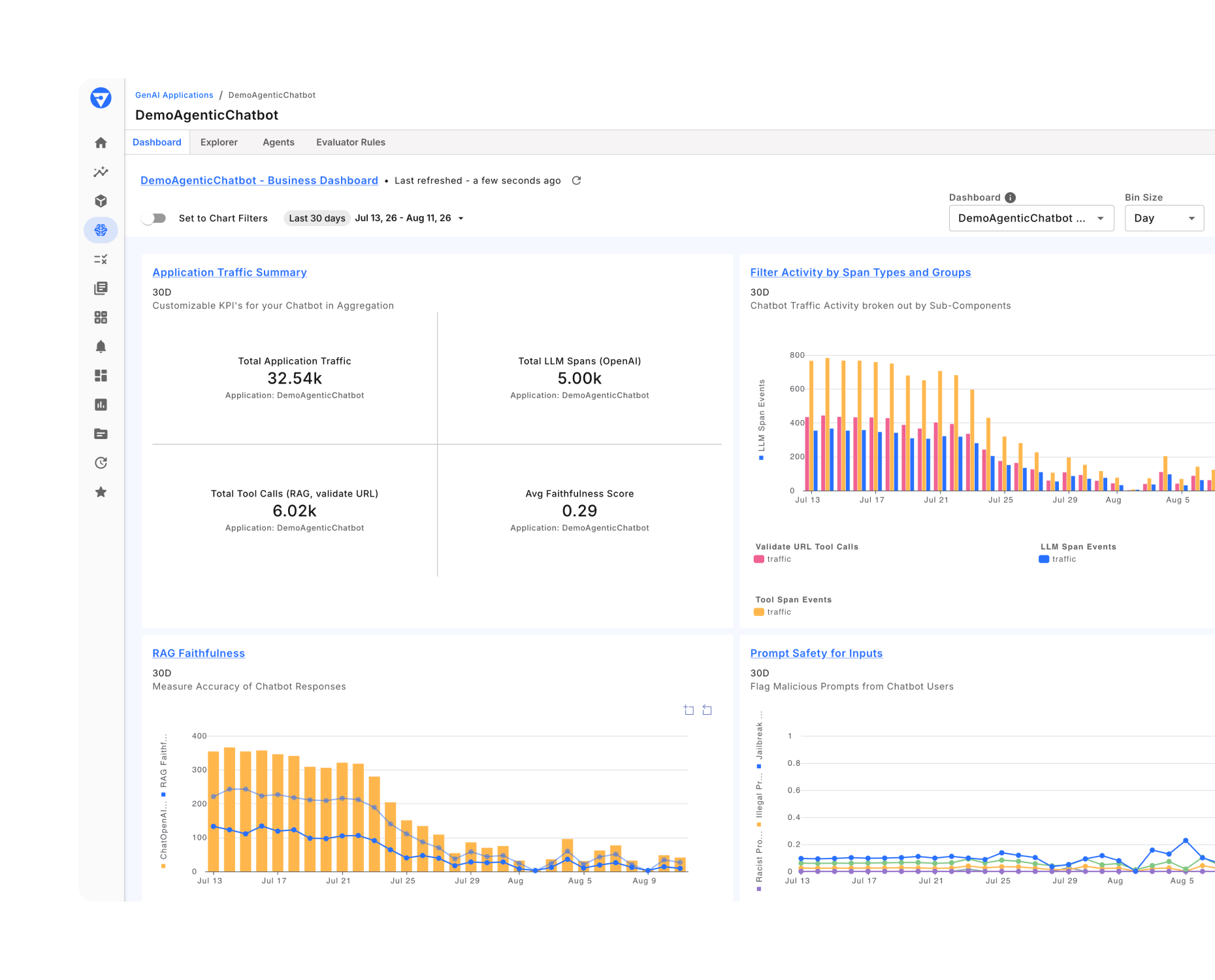
Governance in One Unified View
Fragmented AI deployments across first-party applications, third-party agents, and coding agents create accountability gaps and make compliance impossible. Fiddler provides centralized governance with complete audit evidence and executive oversight.
- Manage all agents from a unified executive dashboard that connects AI behavior and performance to business KPIs.
- Record every decision, action, evaluation, and policy outcome with full traceability.
- Generate evidence for audit trails aligned with GDPR, HIPAA, NAIC, SR 11-7, and other regulatory requirements.
- Track responsibilities, approvals, and stakeholders across all AI applications and teams.

Maximize ROI Across The Fleet
See fleet-wide spend and adoption from individual agent to org-wide rollup, so you know where your AI investment is going. Control costs with Fiddler Centor Models, which run in-environment to power evaluation and guardrails without adding token overhead.
- Gain full visibility into token usage, spend, latency, throughput, and adoption broken down by developer, team, and model.
- Pair cost and performance analytics with security in a single pane.
- Measure token efficiency, usage patterns, and operational ROI across your agent fleet.
Featured Resources
Frequently Asked Questions About the AI Control Plane
What is a Control Plane for AI?
An AI Control Plane is the system of trust for AI agents, providing standardized telemetry, reliable evaluation, continuous monitoring, enforceable policy, and auditable governance across the AI agent lifecycle. Unlike observability tools that only show what happened, a Control Plane for AI agents actively governs what agents can do, enforcing enterprise rules in real-time and preventing violations before they occur.
Why do AI agents need a Control Plane?
AI agents make autonomous decisions that trigger cascading tool calls and policy decisions, which can fail or violate compliance requirements. A Control Plane for AI agents provides visibility into agent behavior, context for decision-making, and control through runtime guardrails. This prevents security risks, enables deployment of high-performance agents that drive business results, and maximizes ROI by reducing incident response time while providing governance and executive oversight.
What's the difference between AI observability and AI Control Plane?
AI observability monitors what agents are doing. An AI Control Plane adds enforcement and governance. The difference is timing: flagging is not enforcing. An evaluator that scores a risk after the agent has already acted documents the incident, it doesn't prevent it. Fiddler observes and enforces on the same request, before any data moves.
How does a Control Plane help with AI compliance and regulations?
A Control Plane provides auditable governance, capturing every decision with full traceability for frameworks like NIST AI RMF, ISO/IEC 42001, HIPAA, SR 11-7, NAIC, and the EU AI Act. Guardrails run in your own environment, so prompts never leave your infrastructure, which is often the difference between a control you can deploy and one procurement won't approve.
What capabilities should an AI Control Plane include?
An AI Control Plane should integrate five core capabilities:
- Standard Telemetry (capturing AI agent lifecycle data)
- Reliable Evaluation (testing agents before deployment)
- Continuous Monitoring (100+ metrics for hallucination, toxicity, PII/PHI)
- Enforceable Policy (runtime guardrails blocking harmful outputs)
- Auditable Governance (complete evidence to support audit trails).
These must operate as a system of trust for AI agents, not fragmented tools.
What are the key use cases for an AI Control Plane?
The Control Plane for AI agents enables business-critical use cases:
- Customer service agents preventing PII leaks
- Healthcare AI agents protecting PHI and blocking biased clinical recommendations
- Insurance agents with NAIC-aligned governance
- Financial services gain full audit trails for regulatory compliance and oversight
- Code generation agents monitored for security
- Business process automation coordinating multi-agent workflows with complete visibility and control
What are the benefits of an AI Control Plane?
An AI Control Plane delivers three benefits:
- deploying high-performance AI agents through continuous evaluation
- preventing compliance risks via runtime guardrails that block hallucinations and PII leaks
- maximizing ROI by reducing incident response time while cutting compliance efforts
This enables organizations to scale AI agents confidently without fragmented tooling or manual oversight bottlenecks.