
Agentic frameworks redefine how enterprises design and scale intelligent systems by providing the foundational structure for developing and deploying AI agents. Using modular components and integration tools, these frameworks simplify the creation of multi-agent ecosystems, reduce engineering complexity, and accelerate deployment. Leading options offer capabilities tailored to enterprise needs, including workflow management, structured large language model (LLM) planning, and predictive machine learning models. These capabilities enable organizations to automate complex tasks, streamline operations, and enhance decision-making with greater autonomy.
When evaluating an AI agent framework, enterprises should consider its ability to support system complexity, ensure data privacy with enterprise-grade security, scale with growing workloads, offer an intuitive development experience, and manage coordinated interactions across multiple agents.
This blog explores what defines an agentic framework, how it differs from traditional AI frameworks, where it’s being applied successfully across industries, and how Fiddler enables enterprises to build autonomous AI systems with transparency, security, and control.
Understanding the Agentic Framework
The agentic framework offers a structured approach to agent development in artificial intelligence. It enables systems to reason, plan, and act autonomously within dynamic environments. Unlike traditional AI systems that follow predefined rules to generate responses, agentic systems leverage advanced capabilities such as:
- Goal-directed: Agents pursue specific objectives based on internal goals.
- Context-aware: They adapt to new information and shifting environments.
- Autonomous: They make independent decisions without continuous human intervention.
- Self-learning: They improve over time by learning from interactions, feedback, and outcomes without explicit reprogramming.
Autonomous vs. Agentic Systems
While often used interchangeably, autonomous and agentic systems represent different levels of intelligence and capability.
Generative AI vs. Agentic AI
Generative AI and Agentic AI are complementary systems that serve fundamentally different purposes.
- Generative AI focuses on content creation. These models generate text, images, code, or speech based on input prompts, making them well-suited for writing, design, and data synthesis tasks.
- Agentic AI integrates generative and ML models into a structured framework, using them to reason through problems, make decisions, and take autonomous actions. These systems support complex workflows that require planning, adaptability, and real-time interaction with dynamic environments.
Key Differences Include:
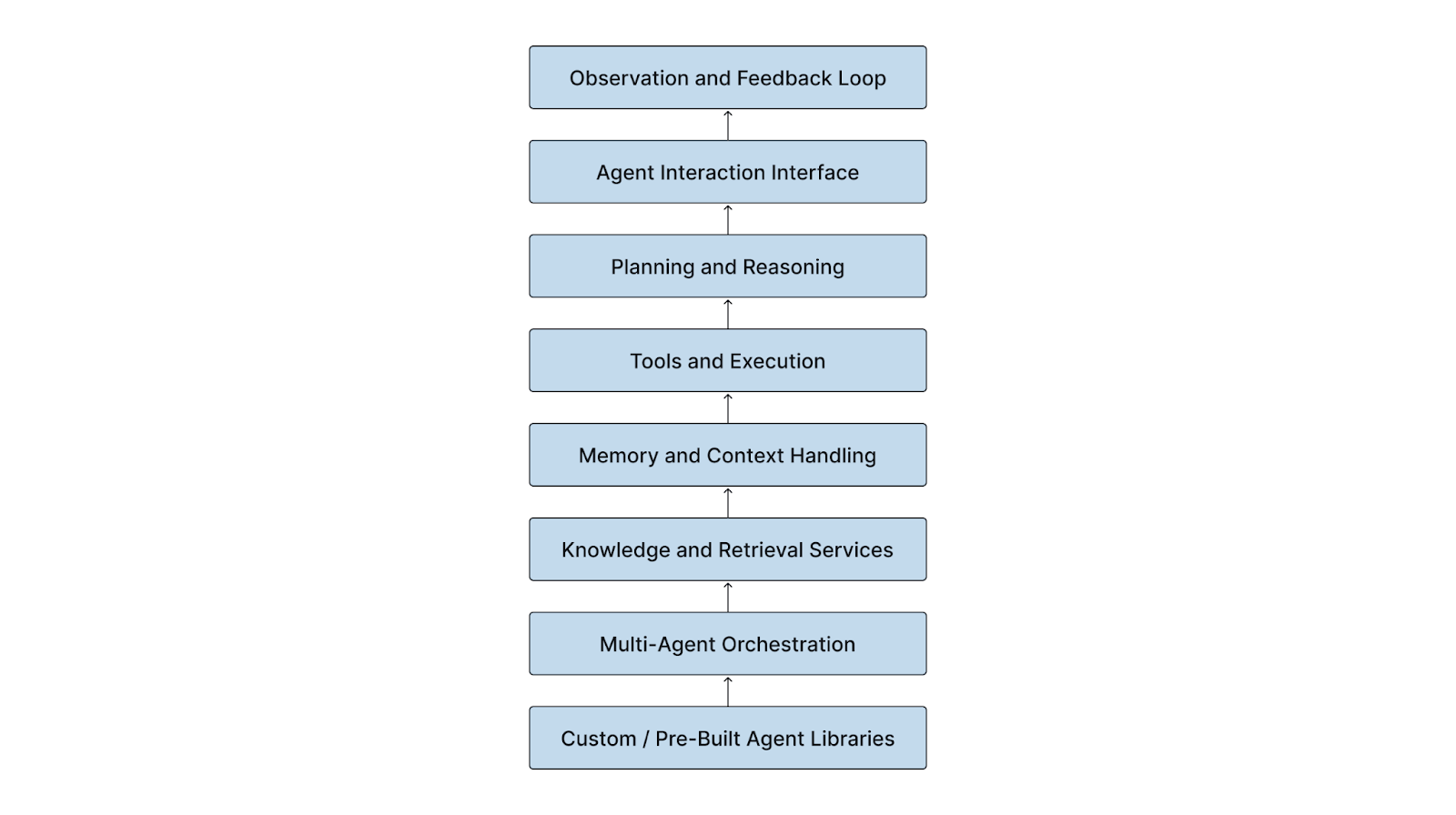
Key Components of Agentic Frameworks
Several core components form the foundation of agentic AI frameworks. The most essential include:
- Planning Modules: Enable agents to devise actions to achieve specific goals.
- Memory and Context Handling: Allow agents to retain past interactions and adjust behavior based on context.
- Tool Use Integration: Facilitate connections to external APIs, databases, or services for extended functionality.
- Observation and Feedback Loops: Monitor agent performance and enable self-correction over time.
- Multi-Agent Orchestration: Coordinate actions among specialized agents working together toward a common objective.
- Custom and Pre-Built Agents: Frameworks often provide a mix of pre-built agents for common tasks and support the creation of custom agents tailored to specific business requirements, accelerating deployment while preserving flexibility.
AI Agent Workflows
Agentic frameworks support the development of advanced AI agent workflows that help enterprises automate operations, improve accuracy, and scale effectively. These workflows allow agents to manage complex, multi-step tasks independently or as part of coordinated teams.
Common use cases include:
- Automating Repetitive Tasks: Reducing manual work in data entry, reporting, and ticket routing areas.
- Enhancing Decision-Making: Using real-time data and context to drive smarter decisions.
- Coordinating Multi-Agent Systems: Enabling specialized agents to collaborate across departments or functions.
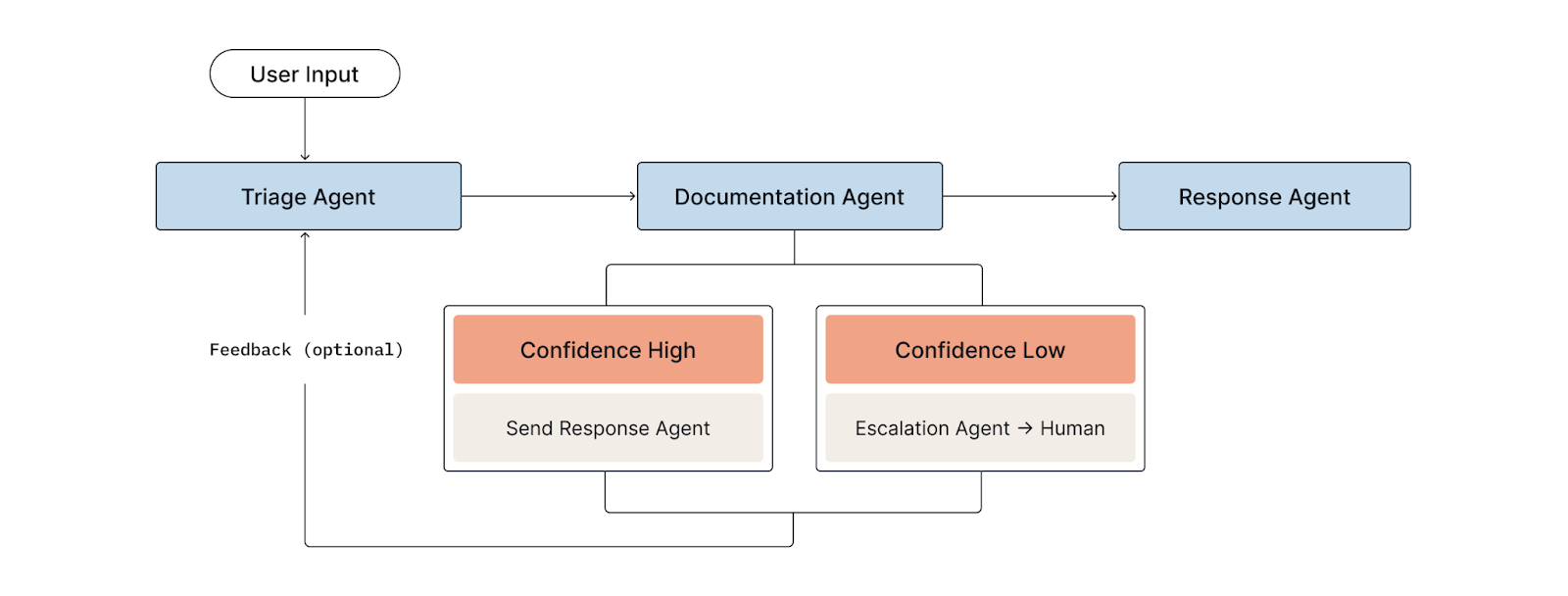
For instance, a support agent can triage incoming tickets, retrieve documentation, draft responses, and escalate unresolved cases, reducing resolution time and improving customer experience.
As these workflows increasingly rely on large language models (LLMs), they require strong observability, security, and governance to maintain production consistency, accuracy, and reliability.
Applications and Use Cases
Agentic frameworks deliver measurable value across various industries by enabling intelligent automation, decision support, and adaptive workflows. The following examples illustrate how enterprises apply these capabilities:
Healthcare
AI agents support clinical decision-making by streamlining patient intake, triage, and treatment planning. They collect and interpret patient symptoms, align cases with medical protocols, and suggest personalized care pathways based on medical histories and relevant research. In healthcare research, agents accelerate discovery by automating literature reviews and synthesizing clinical data.
Finance
Agentic systems elevate financial operations by enabling real-time portfolio management and automated trading strategies. These agents continuously analyze market shifts, rebalance assets, and execute trades based on evolving risk profiles and investment objectives. They also assist with regulatory compliance by tracking policy changes, auditing records, and generating transparent, explainable reports to support oversight and decision-making.
Logistics and Supply Chain
AI agents enhance operational efficiency by optimizing delivery routes based on traffic, cost, and timing variables. They forecast inventory needs using demand signals and manage fleet performance through proactive diagnostics and maintenance scheduling, reducing delays and disruptions.
Customer Service
Virtual agents improve customer experience by delivering 24/7 support, handling routine inquiries, and escalating complex cases when needed. These agents maintain session context, personalize responses based on user history, and adapt over time to improve accuracy and responsiveness.
Education
AI tutors personalize learning experiences by identifying student needs, adjusting content delivery, and offering real-time feedback. They also support educators by recommending supplemental resources and tracking student progress to inform instruction and curriculum planning.
The Future of AI Agent Frameworks
The next generation of AI agent frameworks will focus on expanding agentic capabilities through several key innovations:
- Foundation Models: Large language models (LLMs) will serve as core components of agentic systems, offering flexible reasoning and broad domain knowledge.
- Self-Improving Agents: Through autonomous learning, agents will gain the ability to reflect on outcomes, adapt strategies, and improve performance.
- Cross-Agent Collaboration: Frameworks will increasingly support distributed, hierarchical agent teams that coordinate across tasks and domains.
As these advancements progress, enterprises will gain the ability to build AI systems that:
- Proactive: Capable of anticipating problems and initiating action before issues escalate.
- Collaborative: Able to interact across departments, tools, and datasets for seamless integration.
- Trustworthy: Designed with built-in alignment to human oversight, organizational values, and regulatory standards.
Fiddler’s Role in Supporting Agentic Frameworks for Autonomous AI Systems
Deploying Enterprise generative AI solutions and scaling agentic AI introduce complex challenges that demand deep visibility, context, and control. Agent hallucinations during critical tasks, such as financial transactions, can lead to operational and compliance failures.
Tracing decision-making or assessing accountability after incidents becomes difficult without complete visibility into the underlying agent architecture. Ensuring ethical alignment and system safety is equally challenging without a framework that monitors performance across all layers.
Built for Complex Agentic Systems
Fiddler Agentic Observability addresses these challenges by providing real-time visibility across the complete agentic hierarchy, from system-level health to granular agent actions. It equips enterprises with the tools to build safe, transparent, and high-performing AI systems by enabling them to:
- Monitor agent behavior across applications, sessions, agents, traces, and spans.
- Detect hallucinations, prompt injections, unsafe inputs, PII/PHI leakage, and performance bottlenecks.
- Trace decision paths, tool usage, and plan revisions with complete transparency.
- Maintain fairness, accuracy, and ethical alignment across autonomous and multi-agent workflows.

By making the agent hierarchy visible and interpretable, Fiddler allows teams to understand what an agent did and why it made those decisions. This depth of insight is essential for deploying reliable AI systems that perform complex tasks in high-stakes environments.
Key Benefits of Fiddler Agentic Observability
- Real-Time Diagnostics: Proactively detect and resolve issues across agents and system layers.
- Transparent Auditing: Visualize reasoning chains and decision logic across dynamic workflows.
- Responsible Deployment: Align agent behavior with organizational values, regulations, and ethical standards.
- Seamless Integration: Connect effortlessly with LangGraph, Amazon Bedrock, and other frameworks via OpenTelemetry.
Ready to build smarter, safer agentic AI systems? Discover how Fiddler Agentic Observability enables you to build, monitor, and scale AI applications confidently. Gain complete visibility into agent actions, reasoning paths, and system performance to deploy AI that operates with precision, accountability, and trust.
FAQs About the Agentic Framework
1. What is an agentic framework?
An agentic framework is a structured system for building agents that can reason, make autonomous decisions, and take action in dynamic environments. It provides the necessary architecture, tools, and algorithms to enable agents to adapt, learn from interactions, and operate independently while managing complex agent interactions within modern systems.
Many teams use an open-source framework to customize and extend their agentic systems based on specific business needs.
2. How is an agentic system different from an autonomous system?
Autonomous systems operate independently to complete predefined tasks, whereas agentic systems offer greater adaptability and intelligence. They don’t just execute instructions, but plan, learn, and collaborate with their environment, other agents, or users. These capabilities make agentic systems, particularly those powered by autonomous agents, better suited for complex, evolving use cases.
3. What distinguishes generative AI from agentic AI?
Generative AI produces content such as text, images, or code by learning patterns from large datasets. It works well for tasks like content creation and summarization. Agentic AI, on the other hand, focuses on achieving goals through action and decision-making. Agentic systems use planning, reasoning, and environmental feedback to perform tasks, often leveraging generative models as part of their workflow.
These capabilities make agentic frameworks a critical foundation for building AI-powered applications that require real-time decision-making and task execution.
4. What is an agentic workflow?
An agentic workflow is a sequence of coordinated tasks performed by AI agents to automate complex processes. Each agent may handle a specific function, such as gathering data, analyzing information, or interacting with users, while working collectively as part of a larger system. These workflows help reduce manual effort, enhance accuracy, and enable scalable automation across various business operations.
