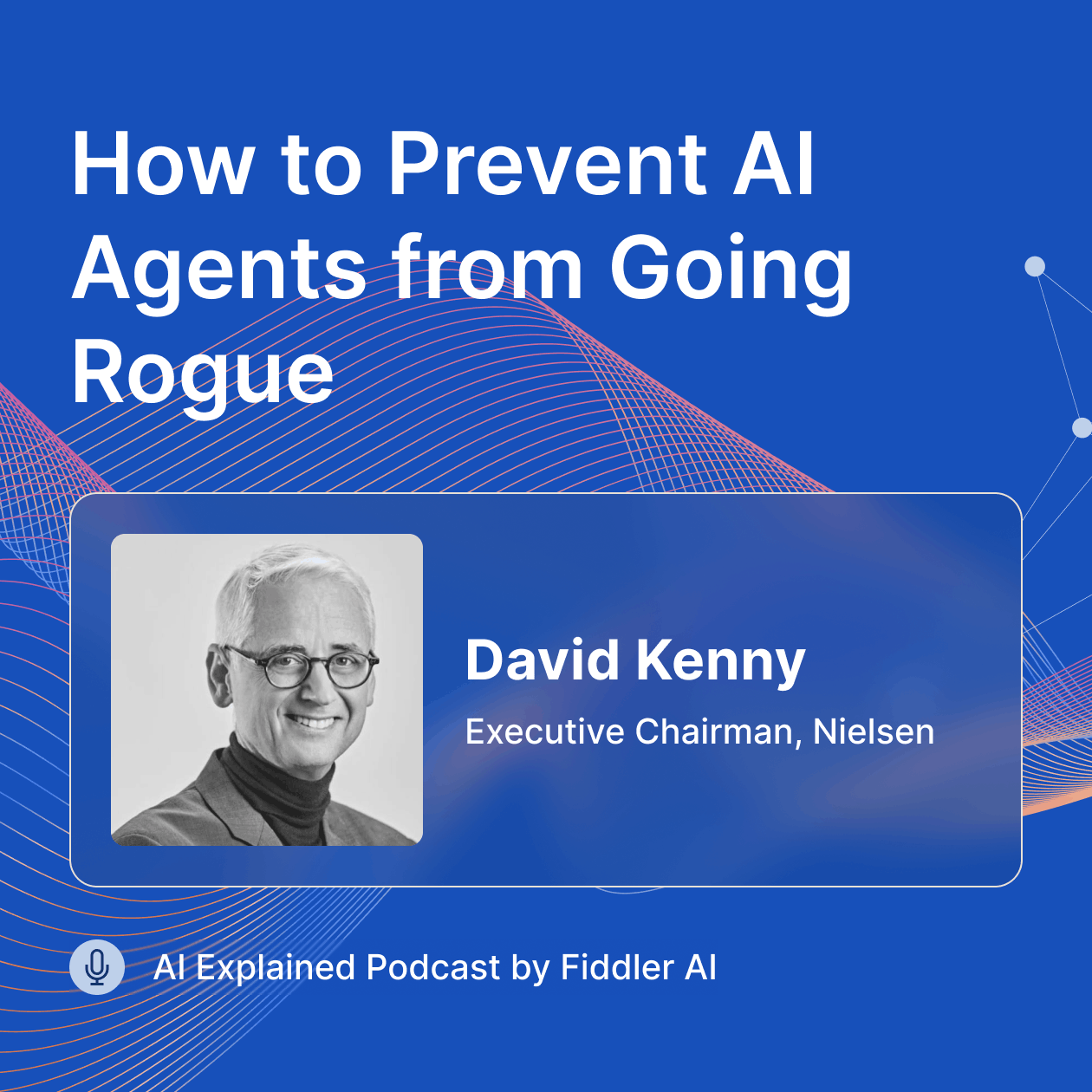
How to Prevent AI Agents from Going Rogue With David Kenny
In this episode of AI Explained, we are joined by David Kenny, Executive Chairman of the Board of Nielsen and veteran AI leader.
He discusses how to prevent AI agents from going rogue, sharing insights from Nielsen's "Ask Nielsen" platform and emphasizing the importance of compound AI systems, real-time control planes, "generally accepted trust principles" (GATP) for AI, fit-for-purpose models, production cost management, and change management in moving from pilot to production.


[00:00:00]
Introduction
[00:00:06] Krishna Gade: Welcome and thank you for joining us on today's AI explained on how to prevent AI agents from growing rogue. I am Krishna Gade, co-founder and CEO of Fiddler AI, and I'll be your host today.
[00:00:19] Krishna Gade: We have a very, very special guest today on today's AI explained. That is David Kenny, executive Chairman of the Board of Nielsen. He led the company's transformation to a digital future and has spent his career building, you know, AI and data science, you know, companies focused on marketing and media, and we'll know a lot, uh, while we go into the conversation.
[00:00:41] Krishna Gade: Uh, today we are gonna explore on how to prevent AI agents from going rogue. Um, with that. I'd love to welcome, uh, David to the AI Explained session.
[00:00:52] David Kenny: There we go
[00:00:53] Krishna Gade: Hello, David. Welcome.
[00:00:54] David Kenny: Hey Krishna. Good to be with you.
[00:00:56] Krishna Gade: Great to be with you. Uh, thanks for joining our, uh, in interviews. Uh, we're very, extremely thrilled to, to be hosting you today. I guess, uh, David, uh, you know, you know, I guess for those of you who don't know you, you are, you are one of the OGs of AI and machine learning back in the day, right?
[00:01:13] Krishna Gade: So perhaps you, you could tell our audience, you know, you've led transformations at IBM, Watson, Weather Company, Nielsen.
[00:01:21] Krishna Gade: Now, how, how does this whole agentic transformation feel to you, you know, compared to the previous technology ships that you navigated?
[00:01:29] David Kenny: what I learned over time was to stop doing transformations because that, that implies that you, you go from something to something.
[00:01:38] David Kenny: But in reality, I think what was important in those companies was to create a culture for constant improvement as technology evolves. And, you know, listen, all the, the beginnings of machine learning were all based on, you know, deductive reasoning or inductive reasoning. And that that meant that there was an answer and you could get to the answer.
[00:02:01] David Kenny: Um, and, uh, you know, now we're doing things that are far more creative. You know, generative uses more abductive and abductive reasoning. So, um, you've just got so much more creative, so many new solutions. They're moving at a much, much faster pace. So I think, um, you know, if there's a transformation for organizations to make now it's to just get themselves fit and, uh, ability to work in very short cycles, see what works constantly improve and know that the machines are actually self-learning and are moving faster with you.
[00:02:38] David Kenny: So I think it's great. I think there's so many. Advances we can make at this pace, but all organizations have to run at a much faster pace and transformed their velocity rather than their operations.
[00:02:51] Krishna Gade: Makes sense, you know, two weeks ago when we both were at Vegas, we heard many company CEOs claim that agents are their new employees.
[00:03:00] Krishna Gade: Right. That they're, you know, they talked about, you know, I'm gonna, we are gonna have 10,000 agents running in our organization, but there is a problem of these agents going rogue, right? Like there is also like, um, things like open claw and mold book coming out. What does that tell us about where enterprises are actually with respect to readiness, you know, when it comes to managing these fleet of agents or even creating and deploying these agents
[00:03:26] David Kenny: Um, listen, I, I, I still think there's an important role for humans, but they are taking on some tasks that we're, are more rote that the humans didn't do. But, but I think humans are able to learn rules. They're able to follow governance. Um, there are checks and balances. Things get approved before they get spun up.
[00:03:52] David Kenny: Um, and there's a code of ethics largely that needs to be put in place before you just let agents actually take action. Or over time they can inadvertently do something that's either unsafe or super expensive or a erodes trust or brings, you know toxicity into a customer interaction. So I, I think it is just really important that you be able to have a control plane just as you, you know, human control planes have a lot to do with ethics and rules and checks and balances.
[00:04:27] David Kenny: Um, I think there, there are other ways you have to observe and do that with agents, but you've gotta do it. Um, otherwise you've just put something uncontrollable into your system and that could lead to unexpected and, you know, perhaps unwanted results.
[00:04:45] Krishna Gade: You know, at Nielsen, you know, you all stand for trust, right?
[00:04:48] Krishna Gade: You measure outcomes across various platforms and, you know, how do you then apply that same rigor to knowing, you know, whether when you go on your agentic journey, whether those agents are doing what you want them to do. And that's, I, I believe that's gonna be quite important for you.
[00:05:04] David Kenny: Yeah.
AI Transformation Journey
[00:05:05] David Kenny: So, um. I, I think this was a real good, you know, collaboration between the customer facing teams, the product teams, the data scientists and, and tech.
[00:05:17] David Kenny: Um, and I think we, we set about, you know, why do people trust us? People trust us because we have a process for producing ratings. We document that process, we're transparent about it. We allow audits. Um, and so we needed to make sure anything that delivered that kind of had the same rules. So we had to put a governance and security plan in place to make sure agents didn't jailbreak into giving instructions that would be unacceptable to our system.
[00:05:48] David Kenny: Um, we actually, well there, there's always bad actors trying to infiltrate a system. And when you've got a system that a hundred billion dollars of advertising trades on, you know. things come after you, um, both people and AI agents, negative ones. So we did a lot of persona playing to kind of go through scenarios of folks who could attack us and make sure our systems detected bad actors and kept them from coming into the system in any way.
[00:06:18] David Kenny: Um, so that was important. I think people also trust us because they get the data real time. They needed to make decisions real time. So making sure we had benchmarks on performance, making sure, um AI was only helping to deliver things faster, not slower. Um, and again, to make sure bad actors don't come in, um, in terms of folks who wanna put, you hateful speech or things that are consistent with our brand, things that are toxic into it.
[00:06:47] David Kenny: Um, so those are the kinds of things we looked at doing. You know, Fiddler was an important tool for us in that still is, um, as we continue to scale. And I think it's just really important that we have control on the agentic actions the way we did on all our other processes.
[00:07:03] Krishna Gade: Makes sense. And, and so the, the Ask Nielsen, right?
[00:07:08] Krishna Gade: Maybe can you, can you share a little bit about how you all went about that that's an agent application for customer facing? You know, uh, maybe you could describe, you know, your journey on that.
[00:07:19] David Kenny: Well, it's, we've, we've always wanted to make our data more useful to more people. Um. There's a lot of, you know, the research arms of the big media companies and the big ed agencies know Nielsen, but there's a, you know, a hundred thousand media buyers out there.
[00:07:35] David Kenny: And making it more accessible was possible with agentic AI. It it, because you could have queries come in, in natural language and you could give them back answers in natural language without a human interface and so, you know, this has long been a dream to make it easier to access. And of course, this work, I don't think we're unusual in that.
[00:07:58] David Kenny: I think a lot of info services businesses have asked Gartner, ask Veris, ask Wolters Kluwer, ask Experian, ask Thomson Reuters. Um, and of course, you know, ask Nielsen. So, um. What, what mattered to us though, given that we're a trust mark, given that we're a currency, was making sure those answers were as clear as possible and, and quite honestly, making sure we used the right models for the right components.
[00:08:29] David Kenny: So LLMs are really good for natural language. They're not good for giving a precise answer there.
[00:08:36] David Kenny: There's not a range or a debate around a rating. There can only be one rating for this show or one rating for this time period. Um, it and it the one that followed the process. So making sure you used more classic forms of ML when you needed inductive reasoning, making sure you're right.
[00:08:54] David Kenny: Use the right things when you need deductive reasoning and the right things when you need creativity and generation and so. Then what was important was making sure that a control plane could actually orchestrate and make sure you were using the right model at the right time for the right part of the conversations.
[00:09:11] Krishna Gade: That's awesome. You mentioned something very interesting. Nielsen has a great heritage of classical machine learning in, in, in activity. The reasoning that you sort of mentioned and, uh. You know, you are not throwing that away. Right. So essentially you are building on top of your work on classical machine learning and quote unquote, what industry calls today, the compound AI, where
[00:09:34] David Kenny: yeah,
[00:09:34] Krishna Gade: you're layering your agent applications on top of that.
[00:09:37] Krishna Gade: Could you share, you know, you know, for example, uh, what are some of the functions where, you know, you are le leveraging your classical ML, and then where is like, you know, agents helping you, I guess you mentioned about natural language query querying capabilities, you know, may, maybe you could delve a little deeper.
[00:09:55] David Kenny: Yeah. Well, so it, um, it depends on what reasoning you need to get to the answer. So when there is a known answer. We wanna use ML that starts with that assumption. And gets to that and has queries that bring that answer
Trust and Governance
[00:10:15] David Kenny: out of the data when there is, you know, a good approximation, we wanna get to that.
[00:10:22] David Kenny: And when there's a need to actually. Extrapolate you want a different kind of reasoning so we, we make sure we have the right model for the right answer. Uh, I think this is true in general, there's, there's a lot of things you should find through semantic search, right?
[00:10:38] David Kenny: Which is again, another kind of form of inductive reasoning.
[00:10:41] David Kenny: Um, people who use LLMs as search engines, hmm. To get a specific answer are wasting a lot of energy and a lot of time, and quite honestly a lot of costs. 'cause you don't need to go through all those cycles. If it's a known answer like, you know, what is the capital of Florida like, there's only one, it is a known answer.
[00:11:02] David Kenny: It can be found much faster through other forms of reasoning. Um, and so what we had to do was sort of break apart the work we do on behalf of our clients to understand. When we were using different parts of our brain. And then make sure as we, as we have AI to help us do that, that we've got the right form of AI for the right component.
[00:11:26] David Kenny: And so back to compound, um, it's the only way that we really got useful. I think there was some early work that you, because there's a lot of agents out there, customer service agents, but we found that they weren't compounding, they were doing everything through a large language model. And quite honestly.
[00:11:46] David Kenny: There were, uh, there were places that just the wrong answer was given. Um, and we can't have that. We can't have that with, with our brand. Our brand is expected to kind of be the definitive truth on audience behavior.
[00:12:01] Krishna Gade: That's awesome. Yeah, we, you know, we are seeing the same effect of the compound AI effect even in like FSI and insurance where people are layering agent skin on top of their,
[00:12:10] David Kenny: You don't want, you don't want hallucination on your bank account.
[00:12:13] Krishna Gade: Sorry. Exactly. Absolutely. Yeah. I think that makes a lot of sense. Uh, instead of just rolling everything in with LLMs and taking all of those risks. Makes a lot of sense. So essentially when you sort of take a step back, right. When you get on this, you know, I mean, you, I don't, I know you don't like this trans, the word transformation, but essentially as you bring this change of culture, as you move to agents and as they take on more responsibility, what's your sort of advice for large enterprises to think about it?
[00:12:43] Krishna Gade: Uh, is this a replacement or an augmentation? You know, any sort of best practices, uh, that you could share?
[00:12:51] David Kenny: Um, it ought to be an augmentation. Just doing the same function the same way, I'm not sure is, you know, necessarily gonna do much for you. Maybe there's a little bit of cost savings.
[00:13:08] Krishna Gade: Mm-hmm.
[00:13:09] David Kenny: Um, but I think if you really look at taking more processes, being able to automate those, extrapolating further and further in in an operating system.
[00:13:20] David Kenny: You can reimagine a company that can provide a lot more functionality, a lot more use out of its services. Um, and I, I think leaning into that is important. I, I think unfortunately, there's folks who, you know, have just created fear when they just talk about how many jobs they're gonna eliminate. They might, but they might create other jobs and, yeah, you gotta look at the total economy.
[00:13:45] David Kenny: So I, I tend to look at like, is. Is there a better way to get more useful information into our customer's hands more quickly? In our case, as a, as an information services business? I think the other thing that's been really important is to understand the workflow of the people who use our data. Cause our AI has to talk to their AI and we, we may have agents producing a rating which may have to feed agents of a media planner and buyer at an ad agency, which might also need to fit into an inventory management system at a, you know, at a video, at a streaming platform.
[00:14:23] David Kenny: And And so, um, making sure that these things all connect can just make things seamless and quite honestly, make them more effective. But to just automate it, I think is not as interesting as then saying, okay, well how does that create.
[00:14:38] David Kenny: New analytics that help you program, how does that create new analytics that help you price? How does that help the end consumer actually find what she wants to watch? So I think, um, making sure you go beyond the function into, you know, the ultimate decision and get deeper into the workflow is the way you create more value.
[00:15:00] Krishna Gade: Got it. So there's this notion of runtime trust that is emerging. And of course recently we have also made a switch from Observability, which used to be post hoc to this, you know, control plane vision. What AI risks do you think require real real-time enforcement, you know, versus like say, you know, post hoc review, like in, in your case as,
[00:15:25] David Kenny: so, so that, that relates to sort
Ask Nielsen Agent
[00:15:27] David Kenny: of my initial answer on transformation because, um.
[00:15:33] David Kenny: Transformation literally was transformed from one thing to another, and then you could, you know, assess that afterwards post-op, right? But if you're actually transforming velocity, which is changing the way everything works at all times and constantly improving, you need to know in the moment how things are working.
[00:15:53] David Kenny: You need to know in the moment if there is anything that. Looks outside the bounds. If there's anything that looks like it could be negative and quite honestly, things that seem to be working better than expected, how do you lean towards those? And so listen, the models themselves are learning at runtime.
[00:16:11] David Kenny: The models themselves are improving every time they run a query and you know, every time they respond to a prompt. So making sure you are in that flow, I think is the way you can help run faster. So to me, I think everything is gonna work real time. There, there may still be an audit process to, to build trust.
[00:16:35] David Kenny: Just as, you know, companies work every day and then you still do audits. You pick samples to make sure that it was work the way you wanted it to. But, you know, net net, I, um, I, I just think shifting everything to real time is the way a company's gotta operate.
[00:16:51] Krishna Gade: Makes sense. So I guess, you know, there's this notion of, uh, policy as code, right?
[00:16:59] Krishna Gade: Like people want into policy enforcement in real time and you know, like, you know, what, what's, what have you seen, you know, how, how is like that being enforced? Uh, you know, in terms of like policy being authored and, you know, like enforced at the agent level? Uh, what have you seen work and where is the, where should we need to improve in that area from a industry perspective?
[00:17:21] David Kenny: So I think what's, what's working so far is, you know, folks who are, are building policies that, you know, have a standard of this has, this has to happen in order to trust it. Um i'm unfortunately, some of those are just trying to apply what we've done before AI and it may not be as real time or useful.
[00:17:52] David Kenny: Um, so I think those who actually have policies that can be assessed in room time, I think are actually more successful at keeping going. 'cause a lot of policies have just slowed down companies and just, you know put enormous compliance burdens on top of, of the tech so you don't get very far. And you know, I'd say early days at Nielsen we had some of that problem.
[00:18:19] David Kenny: Um, and so really, you know, bringing in some folks who came from adjacent industries, particularly retail, which works real-time, um, financial services that works real-time, you know, FinTech, some of those industries have models. That you can bring back to everybody because ev you know, everybody's gonna look more like a FinTech, you know, where you're, you're not dealing with batch analysis, you're dealing with realtime transactions.
[00:18:46] Krishna Gade: So, so I guess like, when it comes to what, what metrics, right? At the end of the day, it comes down to like, you know, how do we enforce these, you know, things, uh, uh, whether, whether it's in a real-time control or a post-hoc monitoring, you need like. You know, so quote unquote, like trust metrics that can be standardized.
[00:19:05] Krishna Gade: Yeah. You know, what are some of the things, like maybe the top three things that you are, you know, you are making sure that when it comes to Nielsen and your agents are, are, are, are being monitored for, and, and guardrail and, and secured.
[00:19:19] David Kenny: So it's a hot button for me because I, I don't think these exist well in the world today.
[00:19:26] David Kenny: So. I'll tell you where I think it needs to go.
[00:19:30] Krishna Gade: Absolutely.
[00:19:30] David Kenny: Because I've been trying to work with some others on this. Um, and I, I saw you in Davos and it was a, a big part of what I was doing there this year. Um, if, if I go back to trust, you probably want the reason that the stock market still works, um, e even with all the craziness in the world is because we have generally accepted accounting principles.
[00:19:56] David Kenny: So we all agree. What defines revenue? What defines operating expense? What defines ebitda? What defines cash flow? What, how balance sheets work? These rules are accepted. There are standards boards, um, that everyone follows, um, and you can't get around 'em. You know, people have adjusted earnings, but the gap works.
[00:20:17] David Kenny: Um, and with all the changes in technology and with all the different ways they're doing. So if you still come back to those standards, you can pull samples. You can audit them and you can have third parties attest. And I think
Compound AI Strategy
[00:20:30] David Kenny: this is why it works, why companies work, why the New York Stock Exchange, and NASDAQ work.
[00:20:37] David Kenny: So in an AI world, how can you get to generally accepted trust principles? Um, and I think we gotta have to do a similar, and you gotta remember that there was this craziness that led up to the Great Depression. Before there was FASB, before there were standards boards, before there was GATP. Mm-hmm. Um, it's, it's really just a hundred years old and so I, I think AI is at that point where everybody who's using AI to interpret and then produce data information.
[00:21:13] David Kenny: Needs to do this. And I, so, you know, I think it's going to, I think it's gonna take an industry by industry approach. In the media industry. There is a Council in America, the media rating council that kind of agreed to define what a rating was. Um, they've been working hard at digital ratings and now, you know, AI.
[00:21:29] David Kenny: So I think it's one example. Um, but net net, and I think the people who do the accounting standards have to understand where AI fits into the audit process. More broadly, I think you've gotta agree this is a standard for a true set. This is the way you can have empirical evidence to back that up. Um, so that it's you.
[00:21:54] David Kenny: I'm, I'm all for synthetic data's role in training. I'm not for synthetic data being truth, it's my definition not so, um. Truth has gotta be something where there's a standard, where you can attest to that standard, where you've got empirical evidence against that standard. Um, and that everything that derives from that you can know is true.
[00:22:15] David Kenny: And so, I, but I, I think this has to happen. Um, I think companies can build companies specific policies that are somewhat helpful. But I actually think there's some, you know, industry-wide work that needs to be done. Because without generally accepted trust principles, I worry that we'll end up with some, you know, speculation and, and market imbalance.
[00:22:45] David Kenny: Um, as we did, you know, in the, in the run up of the twenties before we had this, you know, massive correction when people figured out there was a lot of fake information in the stock market. And so, um, I'd love to avoid that if we could.
[00:23:01] Krishna Gade: Mm-hmm.
[00:23:01] David Kenny: Um, by getting about this sooner versus later.
[00:23:05] Krishna Gade: Yeah, it's awesome. Like GATP for AI, you know, that's a pretty interesting concept to think
[00:23:09] Krishna Gade: about.
[00:23:10] David Kenny: GATP.
[00:23:10] Krishna Gade: GATP. Yeah. That's, that's pretty cool. Uh, that's awesome. Uh, so I guess that's probably, you know,
[00:23:16] David Kenny: we probably don't have a lot of CPAs on this call, but they should realize they have a new purpose.
[00:23:22] Krishna Gade: That's true.
[00:23:23] Krishna Gade: Actually. That's, that's actually raise a very interesting question, right? So when we, uh, speak to organizations. There are multiple teams that are thinking about this control plane concept. There's of course the, the developers that want to ship AI and there's the, the sort of the IT that's looking into bringing agents and, you know, first party and third party, and there's security teams that are trying to enforce these, uh, you know, policies.
[00:23:49] Krishna Gade: You know, how do you see this all from an organizationally, where does control plane fit? You know, and how, how do you think where, you know, it sort of offers like the, the maximum value and, and, and sort of, uh, from an organization point of view to, to get on this journey?
[00:24:03] David Kenny: Ultimately it's a C-suite issue because I think, you know, there's a reason why chief executive officers have to sign off on GATP. Like would, when you run a public company, you have to sign that you're attesting to these being true. And of course, the finance team and the CFO and the audit team all did their work, but you're ultimately accountable.
[00:24:27] David Kenny: Um, and I think that's true here. So, um, if, if you're controlling a system and particularly the output of a system, um, you've gotta attest to it being truthful. And I think that actually raises the bar on, on how you do it. I think you also get to the materiality, like which things could fundamentally cause harm to the company, its reputation or to a, a customer, right?
[00:24:52] David Kenny: So, um, that certainly drove us. Then of course, you know, your, your, your tech team and your, your data scientists are gonna go deploy it, but I think you've gotta be close enough to it when you're running a company. That, you know, you can attest to truth coming outta your company 'cause you're not gonna be able to blame the AI.
[00:25:14] Krishna Gade: We don't have any to get away with it. Yeah,
[00:25:16] David Kenny: We, we don't have any bots as CEO yet. Um, and I would be hard pressed to invest in that. Like, so you, you've actually gotta have accountability for how your system works. Uh, at the highest level, it's, it's why I pay attention to this and, and then it gets deployed by the team.
Runtime Trust & Control Planes
[00:25:35] Krishna Gade: Yeah, that's awesome. There's actually a relevant audience question from Robert Heath, uh, says like, do you think companies should be, should begin incorporating service design practices such as mapping users, processes and technologies to support agents cause it machine users as they navigate these complex systems?
[00:25:54] Krishna Gade: This could help prevent agents from behaving unpredictably while also increasing transparency for the humans who interact with or oversee them.
[00:26:02] David Kenny: Well, I also think, and it can speed up implementation, right? So this is, um, I think you should map the way the process works today, but then you've gotta imagine how the process could be better.
[00:26:15] David Kenny: ' cause the advantages of agents is they work 24 hours a day, seven days a week. Um, they're constantly making little improvements. So rethink, how could this work in a, in a, a different kind of system? Um. So that you're, you're actually taking full advantage of it. I, I think it's important. I also think, uh, making sure those systems are not just within the company's walls, but through the supply chain coming into the company and through the value, value chain going out to the customer on the other end.
[00:26:49] David Kenny: Because I think the, the, the notion of a company adding value is gonna be end to end. Um, so understanding both ends of it. Adding value at both ends to it using agents, uh, is gonna be great. So you gotta map all those processes, not just the ones that are within the company today.
[00:27:09] Krishna Gade: Yeah, makes sense.
[00:27:10] David Kenny: But then be willing to see the processes improve as agents become a part of 'em.
[00:27:17] Krishna Gade: I, I think there's also this tension, right? Like when it comes to the operating model, you know who owns it, but also like how do they balance it? Now, I used to work at Facebook before starting Fiddler, and they were famous for like move fast and break things type of notion. Yeah. Now there is this tension between how do we balance these safety controls with developer velocity.
[00:27:35] Krishna Gade: You know, there's there's like a FOMO effect now. Every three months, you know, things are, you know, every week things are changing, but every three months it seems like a big shift that's happening in the industry. Um, what, what's, what are your thoughts on that balance between, you know, safety and the developer
[00:27:54] David Kenny: Well, and now of course, you know, you're doing genic coding, so the developers are even faster than ever,
[00:28:01] David Kenny: Um. I, I think I, I don't think safety can slow you down. Safety can actually also guide you. So I, um.
[00:28:16] David Kenny: I think at a certain scale of breaking things is irresponsible and damaging to society. So I, I would actually say there's a big difference between speed and velocity. Um, so in physics, speed, just going fast is a great way to have an accident and die. Velocity is speed towards a destination. So defining that destination and making sure you've got velocity towards that destination, um, and having developer velocity versus developer speed, I think is super important.
[00:28:53] David Kenny: And part of that destination is being really clear what the values are around toxic content around. Safety around use and misuse around truth. Right? Um, so having those principles in place like GATP and the safety, putting those principles in place, having design systems that can get as fast as possible within that actually increases your velocity because you're more clear about the destination, um, and you don't waste energy going fast in ways that are actually harmful.
[00:29:30] Krishna Gade: Yeah, absolutely makes a lot of sense. It's like the best practices in software development that we need for agent development lifecycle. So, so I guess, um, you know, there's a, a big portion of what you do at the Nielsen is to be open for audits and, you know, like, what, what do you think when it comes to AI decisions, what constitutes like audit ready evidence?
[00:29:56] Krishna Gade: You know, people talk about, you know, okay. If you wanna bring in GATP type principles into AI, you know, companies should be able to like, you know, open for audits, right? Like, you know, what, what do you think like an, an auditory evidence for AI decisions meets constitute?
[00:30:12] David Kenny: Can you give me an example? I'm just trying to make sure I,
[00:30:14] Krishna Gade: Like for example, let's say you have an agent and you, it's misbehaving. And if you wanna, like, you know, what do you, what do you have to record from an agent perspective? You know, like, so that you know you are making it available for a, for a third party audit or even an internal audit.
[00:30:32] David Kenny: Um. Well, first of all, you have to have standards on that, right? So other way to know what is misbehaving,
[00:30:40] Krishna Gade: right?
GATP - Trust Principles
[00:30:41] David Kenny: Um, so you know, to me, you know, we, we, we've, we've got some standards around back to compound ai. Did you use the right AI for each?
[00:30:51] Krishna Gade: Right?
[00:30:51] David Kenny: Did the right AI produce the answer for this component?
[00:30:55] David Kenny: Um, so does it work in that way? And then within each model, um. Was it useful? Did it follow our guidelines? Uh, did it move quickly? I mean, that's all information. I, I think the other thing we, you know, we do spend time on is just did it get there most efficiently? Like, hmm. A lot of AI right now is not saving money.
[00:31:19] David Kenny: It's costing money. It's just maybe replacing some human hours with compute costs, but sometimes the compute cut is, are even higher. I, you know, I'm, you know, really amused by notebook right now, but some of the folks I know who put their agents in there have gotten really big bills.
[00:31:37] Krishna Gade: Yeah.
[00:31:37] David Kenny: Because because they don't have a constraint.
[00:31:40] David Kenny: Um, and so I, I think we watch all of that. We watch cost benefit. We watched, did it work the way we expected? Were the answers there and, and did it block, you know, harmful queries or, or, or toxic content? And so you, those are the things that work for us today. Gonna go back to GATP, if we get even more clear on, you know, what are the things that really, you know, guarantee that.
[00:32:12] David Kenny: The answers given were truthful. Um
[00:32:14] Krishna Gade: mm-hmm.
[00:32:14] David Kenny: You can trust them and that they weren't, um, manipulated in some way.
[00:32:20] Krishna Gade: Mm-hmm.
[00:32:20] David Kenny: Um, you know, all the better. So
[00:32:22] Krishna Gade: Yeah. Basically an audit log of, of your agents. So, so I guess, you know, you mentioned something very interesting that, uh,
[00:32:28] David Kenny: well, and I think it is then important that you can go back and pull empirical evidence.
[00:32:32] Krishna Gade: That's right.
[00:32:33] David Kenny: Um, to compare to what came out of the model. And I think you have to do that on a sample basis. You can't do that on the whole, on everything, although your control planes can tell you, you know, where you might have potential weakness that you wanna go collect the data.
[00:32:48] Krishna Gade: Yeah.
[00:32:48] David Kenny: Um, that helps.
[00:32:51] Krishna Gade: Yeah, absolutely. So, so have you seen examples where, you know, you felt like the agent was working really well, but, but actually was optimizing the wrong thing, you know, like, so were there some examples that you can think of?
[00:33:04] David Kenny: I think there are places, and I, I've seen this in, um, in here, but I've also seen this agentic commerce, where people like the human interaction, but when it, when it does the function that used to be done by semantic search. It's actually not recommending the right products. So, um, and you, we see this a little bit in, in discovery of for entertainment content, which, you know, we support through the Gracenote outside of Nielsen.
[00:33:35] David Kenny: Um, and, and I've seen where, you know, the same question will produce different recommendations Three different times in a row, and that probably isn't right. Right? Because semantic search used to be able to get you to the right products in a big marketplace. And so I, I think there are places where it's just fundamentally the wrong tool.
[00:34:02] David Kenny: Um, and the only use know that is that you people are buying less because you were. Teeing up the wrong answer to them. And the way you kinda solve that is that you go to something that's compound and that's when you know when, when it's compound, you actually absolutely need a control plane because there's no way to be looking at three different models at once.
[00:34:25] David Kenny: But I, you know, I think that's a way you're getting people what they were actually looking for. Same thing, you know, for as Nielsen, we gotta make sure when it, you know. When it's against the add intel business on a global basis, and you wanna know, you know, where, where did your com, your competitors advertise versus you?
[00:34:45] David Kenny: It needs to come out with the right answer and that answer is known. So you, you use LLMs to get the question and get general thing of what you're looking for, but then it's gotta go pull the right answer and give the same answer every time.
[00:35:01] Krishna Gade: Yeah, so, so we discussed a few things here, right? One is, of course you need a control plane for real-time enforcement, for potential auditing and collecting, you know, bad examples of what went wrong and you know, like how do you recommend enterprises start with it?
[00:35:16] Krishna Gade: You know, like when do they start with like having a control plane? Is it like a post hoc thing or do you have to start with like when you are on an agentic journey? Any advice?
[00:35:27] David Kenny: Um. Listen, I would start earlier. You know, I, I, I get the logic we're, we're experimenting so we can use different tools and when something goes into production, we need a control point.
Audit & Accountability
[00:35:38] David Kenny: Um, I just find it so helpful to observe at runtime what's going on. It, it helps you move faster towards something that you can put into production. And quite honestly, I think people have to hold themselves accountable. Experiments that don't move into production within a few months. Should probably be stopped.
[00:35:59] David Kenny: Um, I, I think having cool widgets to show your board once a quarter is not creating value for anybody. So, um, I, you know, I, I really do. I do think people need to actually manage scope to things that in production could be meaningful from a value standpoint. Um. That leads you to sort of having a control plane sooner versus later.
[00:36:23] David Kenny: So you've got confidence to put it in production and that you can actually, as you're developing and designing and doing things, you know, to a, to a small set first, you, you can see how they work and then you can improve the way they operate and you can see, you know, where else you need to actually put in more governance.
[00:36:44] David Kenny: So I would design it from the beginning with that, because I think it's to me, a control plane is kind of, you know, athletes now wear a lot of sensors, like all these guys over in Milano. Um, you know, they have a lot of wearables when they're going downhill. They have a lot of wearables when they're out on the ice ring.
[00:37:03] David Kenny: Um, and that helps them get better. Right? And there's a, and there, there's a lot of images that you, and all that data is really useful. You have a control plane's kind of the same thing. It's wearables inside your agents. So that you can make them better, you can coach them to do better. And so I don't, I don't think you just wanna put it on after you've designed everything.
[00:37:25] David Kenny: Because that's not gonna optimize. It's gonna actually be helpful to associate work as plan, but if you actually wanna build it right in the first place having the data along the way really helps
[00:37:40] Krishna Gade: Absolutely. And,
[00:37:42] David Kenny: and we didn't know that at first. We put it on after we like done the early Ask Nielsen work, but since then it is helped us get to faster improvements in iterations because we had the data and then we'd have the data a year earlier.
[00:37:56] David Kenny: We probably would've gotten to market faster and more effective out of the gate.
[00:38:01] Krishna Gade: Awesome. And, and you've been, uh, you know, you've been a, uh, you know, CEO and you know, leader of like large, you know, an enterprise company. You know, there are a lot of audience, you know, who come from product risk. Security teams that might be listening to this, how do you like, suggest to them and how do you know, how do you, how do they get an executive buy-in, you know, like to get in, like to get started on this journey.
[00:38:23] Krishna Gade: Right? So, you know, what is our advice for, for folks, you know, to, to get an executive buy-in for a control plane or observability?
[00:38:33] David Kenny: Well, it starts with experiencing AI directly. Um, so the as you noted at the top of this, you know, my, my first company did the first banner ads on a AOL, CompuServe, and Prodigy in 1995.
[00:38:50] David Kenny: So, been at this for a while, but I remember in 1995, 96, um, just at the beginning of like email, how many senior executives would print out their emails, write the response, give the emails to their assistant who would type their response back in this did not have a productivity game. Um, and, and I, you know, and then I look at like all the, you know, just the whole email culture until we got things like Slack that we just communicated very in.
[00:39:28] David Kenny: And this still exists to some extent. Um, and I see so many people. You know, their knowledge of AI is using ChatGPT as an alternative to semantic search. Um, Gemini's a little better 'cause Gemini's actually compounded the backend so they, they didn't lose the advantages, but I'm like, don't be that person.
[00:39:54] David Kenny: So, you know, I really, everybody I know, I tell 'em, go to Coursera, take a basic, prompt engineering course to start with. Build an agent, build any, you can, you know, you can build an agent in natural language. You do not have to be, you know, proficient in Python to do so. Um, or know JS or any of this stuff. Like, just you can do it.
[00:40:15] David Kenny: And so, um, and, and they work pretty effectively. So I, I, I encourage people to try. You can't hurt yourself to try, try something small, get used to it, therefore you've got more. You know, proximity when you're starting to have these discussions about how it's gonna work in inside the company. Um, but I think people would just say, we need to do AI.
[00:40:42] David Kenny: Here's a million dollars. Go knock yourself out. See what you can do. I'm not sure much it's gonna come of that. I think it's gonna be a lot there, there, it's gonna be like a lot of the, you know, internet experiences. We just went through this with a bunch of Metaverse stuff, Web3 stuff.. like. This stuff can really create more value if you use it.
[00:41:03] David Kenny: The more people in the company, including key decision makers who have familiarity personally, the better your answers are gonna be.
[00:41:12] Krishna Gade: Yeah. That's awesome.
[00:41:14] David Kenny: Otherwise, you're gonna get, you're just gonna get displaced by AI native companies who just start from the beginning with a different system.
Enterprise Security
[00:41:23] Krishna Gade: Right, right makes sense..
[00:41:24] Krishna Gade: And, and so there's also, um. There's a, there's emergence of these, um, agents like agentic social networks, right? Like, and people can, you know, download and install an open claude or, or even like maybe a third party agent. And, you know, there's this a huge, you know, enterprise security problem as well when employees are running, you know, agents on their company laptops and whatnot.
[00:41:51] Krishna Gade: So how do you think like you know, C-Suite should be prepared for that. You know, that seems like a pretty, pretty interesting governance problem
[00:42:05] David Kenny: Yeah. And on the other hand, if you, if you clamp down too hard, you people will find another way to use it. Yeah. And And you'll, and you'll be outside the the system anyway.
[00:42:18] David Kenny: Um, so I think you've gotta lean into what helps people be the most productive, what tools do they wanna use? Um, but have some guidelines and, and quite honestly, you know, having a control plane across the enterprise, um, that it watches data to make sure data doesn't go out, it doesn't get posted in wrong places, that you've got some track of how things were done.
[00:42:46] David Kenny: But it also is nimble enough that it allows people to create new things, is the right answer. You do have to balance both, um, initiatives. Um, I think this is, you know, regulated industries with heavy compliance.
[00:43:02] David Kenny: You know, we, we are in effect industry regulator. You know, my friends in financial services I talk to a lot, healthcare, I talk to a lot. Um. You, you, you wanna have some tools that make sure you stay compliant as opposed to clamping down everything. Um, and then encourage people to build things and try things, um, and, and build new solutions.
[00:43:27] Krishna Gade: Absolutely. And, and maybe like, uh, you know, is, is was there a fun agent? thing that you tried, you know, like any, any, any experiences that you tried to build your own agent or tried something out that you've, that you had a interesting experience that you wanna share with our audience?
[00:43:45] David Kenny: The, uh, what is, um, right now I built my, so, um, I'm looking at, you know, I'm in the media business portion. Yeah. So I look at entertainment. Um, Mo most people don't care about. Platforms, like there's that brand loyal, there's a little loyalty to Netflix, but what they really care about is I get to Bridgerton or I get to Sunday football, or I get to a college basketball game.
[00:44:17] David Kenny: So, and to build an agent, they, they actually could find out what platform something was on and then set me up to, if I didn't already subscribe to that service to subscribe me to it. But then to remind me to cancel it afterwards, right? So, so that I didn't just end up with too many subscriptions. And I, you know, A, there's a, there's a lot of money if you manage your subscriptions more aggressively and AI helps you do that.
[00:44:45] David Kenny: But then I realized how this could help with so many other subscriptions, right? Um, including software as a service. Like, can you really like buy it, buy it, just when you need it, and, and the other side is how does subscription terms work? Um, but I, I think there's a whole bunch of, of ways to help people save money and actually get to the answers they want faster by extrapolating above the app.
[00:45:14] David Kenny: And so, so now I'm looking at, can I do this across all the apps on my phone? Like, I don't know what about the rest of you, but going through, you know, pages of chiclets. Search helps somebody an an agent that actually says, this is what I need to do, and it tells me, here's the app you need it, installs it. If you haven't already installed it and it deletes the ones you haven't used in three months, can you know?
[00:45:38] David Kenny: I think it's your phone back to a beautiful screen with all the apps behind it.
[00:45:44] Krishna Gade: Yeah. Amazing. Yeah, I was actually, personally, I got hooked to Gamma, like I was trying out to, I, it's so effective how, you know, it just take, it just creates like slides for you with little, little effort and it was just like amazing actually how, uh, these agents are able to do tasks for you and make you know,
[00:46:01] David Kenny: but I think it's important to, to build one yourself.
[00:46:03] David Kenny: Like that's
[00:46:04] Krishna Gade: Absolutely. Yeah.
[00:46:04] David Kenny: But you were asking like that's the, uh, I've been really interested in some that can work, in know, Khan Academy is doing stuff. I, I'm also involved with Teach for America and like the the, the, the role of AI in tutoring, I think can fundamentally improve education for kids. Um, and if that works, then you can bring that back to the training.
[00:46:26] David Kenny: We've all gotta retrain our workforces. Um, you know, I mentioned Coursera, but is there a way to actually build more tutoring to help bring people along? And I actually think the younger people in organizations, like the kids coming outta college right now is starting to use it as an operating system.
[00:46:44] David Kenny: They should build tutoring for people at my level to learn what's possible. So, you know, I want some of the new best and brightest people hired at Nielsen to actually. Make an agent to tutor me on all the things I don't know yet.
[00:47:05] Krishna Gade: Oh, that's, that's a great use case. So, uh, you know, as we sort of, uh, wind down this conversation, right, so like, I guess there's this famous MIT article that came out last year that 95% of genAI projects are, you know, kind of get stalled in pilot phase.
Key Takeaways
[00:47:21] Krishna Gade: What's your maybe three takeaways that you suggest to enterprise leaders that would be listening to the podcast? How do they get past that? Pilot phase into productionization of their gen, AI and agent workflow. What, what are the three things that you take aways from this conversation that you could, that you would like to suggest to our audience?
[00:47:39] David Kenny: One, I, I think a lot of those failed because people wanted LLMs to do everything. Um, and listen, generative pre the, what they did with the transformer models is amazing and but also took a lot of compute. So, you know, number one is fit for purpose. Understand the difference between a basic machine learning model, um, a, a semantic search engine, an LLM, um, and solve it with compound like there, there is no master algorithm that solves everything.
[00:48:21] David Kenny: I know that's a dream of some folks, but in your own organization, you have different people who are expert at different things. The same is true for AI. So one, know the difference and make sure you fit for purpose. Number two, you know, always look at production costs. You know, a a, a lot of reasons these things failed is that the cost of compute was greater than the economic benefit out of the gate.
[00:48:49] David Kenny: Now, that was true in the beginning of the internet too. So, um, you know. Fit for purpose will help you. But really making sure you're engineering with unco in mind, you know, at production I think is key. 'cause that also helps you from getting things that aren't there. And then, um, lastly, most AI to be useful requires a change in the way the humans work with it.
[00:49:15] David Kenny: So, um, a, a lot of people miss the human interface side. Just like a lot of the early web people miss CX, right? Let's, let's, because there were a lot of search engines. Nobody was as simple as Google. I was on the Yahoo board at the time and it, um, interfaces matter, you know, and I think teaching people how to use AI as an operating system is key.
[00:49:41] David Kenny: Again, I think younger folks learn it faster 'cause they have less to unlearn. Um, which is why, you know, I think reverse. Behavior change from the newest employees up to the more senior employees is really gonna help you get that part right. So, um, like anything, it's a, it is a change management system.
[00:50:00] David Kenny: It's not just introducing an AI agent that does what a human did differently. Yeah. I, I'm not sure that's, there are a few places that works, but there's a lot that it doesn't.
[00:50:12] Krishna Gade: Awesome. That's great. So simply put, embrace compound AI, you know, take cost and security and all of these things that can into account, and get on like a culture, you know, change management within your organization.
[00:50:25] Krishna Gade: So. Great takeaways. Uh,
[00:50:26] David Kenny: As always, you're far more succinct than me.
[00:50:30] Krishna Gade: No, no, it's great actually. Thank you so much, uh, David, for sharing your valuable insights and wisdom, um, for all of our audience. And, uh, it was lovely working with, with you, uh, and, and in the last year or so. And, you know, thank you so much for all of your support, for Fiddler.
[00:50:46] David Kenny: Thank you for all you're doing it. Uh, it's great to have control planes that can help us trust the agents, so thank you.
[00:50:53] Krishna Gade: Thank you. Awesome. Thank you, uh, everybody. Uh, this is, uh, basically we have come to the end of the, uh, AI Explain for this week. Uh, you know, thank you so much for joining, uh, our podcast.
[00:51:07] Krishna Gade: We'll come back with another amazing guest, in, a few weeks timeframe.