

Key Takeaways
- AI evaluations have forced a tradeoff between cost and coverage: send everything to an external model and costs balloon, or sample and risk missing what slips through.
- Centor eliminates the trade-off between evaluation cost and coverage by running every input and output through purpose-built Centor Models and choosing the best way to evaluate each one, without sharing your data with an outside provider.
- Dynamic Model Escalation, a new Centor capability now available for Centor Model for Safety, improves accuracy by automatically handing the small share of inputs that fall outside what a purpose-built Centor Model was trained on to a larger Fiddler-hosted general-purpose model, with no external API call. Only that escalated share sees added latency.
- Example result: on one reference dataset, escalating just 3.1% of inputs, we reduced the overall jailbreak false positive rate by 93.5%, cutting the triage queue for security teams.
As agent traffic grows, AI teams evaluating at scale keep running into the same problem. They can have accuracy, speed, or low cost, but usually only two of the three. Teams are left choosing between:
- Sending data to an external model at OpenAI or Anthropic for a sharper, more accurate evaluation, and costs can balloon fast.
- Sampling a fraction of inputs to keep that cost in check, and hoping the inputs that slip through don’t turn into expensive, reputational risks down the line.
- Running slow evals that either hold up the end user’s response or let a bad output reach them before it’s flagged.
At Fiddler, we believe every input and output deserves 100% trace coverage without trade-offs, and certainly not just good enough evals to pass compliance. Teams are trusting agents to run their business, and they need full coverage without trade-offs. That’s why we built Centor, and today, we’re announcing Dynamic Model Escalation, a critical capability in Centor that helps AI teams improve accuracy without making teams give up speed or cost.
Your Data Runs Through Centor. Centor Decides The Rest
Teams don’t have to choose or decide for themselves which inputs should be routed to which model. Centor does that for them by automatically sending each input to the best suited model, to evaluate it, whether that’s a Centor Model or the general-purpose model, without sharing your data outside of your environment.
Batteries-included Centor Models, the specialist evaluators behind Safety, Faithfulness, and Sensitive Information scoring, are task-specific and real-time, handling the vast majority of that traffic quickly, with no per-call charge from a third-party provider.
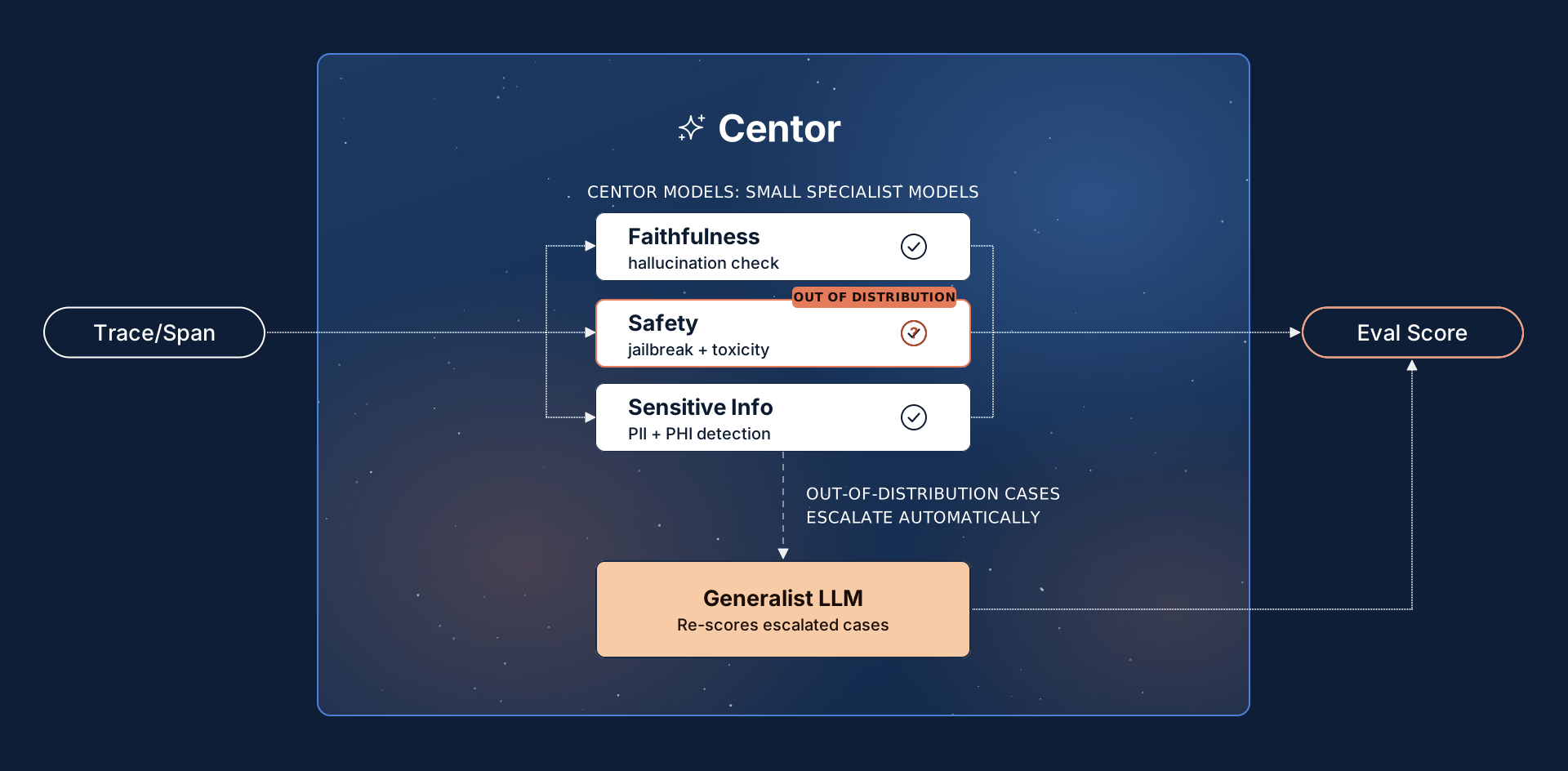
Dynamic Model Escalation is now available for the Centor Model for Safety. When an input falls outside the domain on which the small specialist model was trained, it’s automatically handed off to a Fiddler-hosted general-purpose model for a second evaluation, still within Centor and with no external API call. On Fiddler’s SaaS-hosted Centor, escalation comes at no added per-eval cost to customers, and only the small escalated share of traffic takes on added latency.
The Centor Model for Safety includes Dynamic Model Escalation as an option. Turn it on for added accuracy, or leave it off and keep scoring with the model on its own.
Where Accuracy Gains Show Up
When an input differs from what the Centor Model for Safety was trained on, it identifies this using the same embeddings it already produces while scoring. That means detecting them doesn’t require a separate model or any additional computation. Only that smaller set of inputs goes on to get a second evaluation from the general-purpose model.
During the development and production testing of Dynamic Model Escalation, a customer tested data with Centor Model for Safety. By escalating just 3.1% of inputs, we reduced the overall jailbreak false positive rate by 93.5%, drastically cutting the triage queue for security teams.
Teams evaluating AI inputs shouldn’t have to decide upfront between fast, cheap, and accurate. With Dynamic Model Escalation, Centor makes that determination automatically, so overall speed and cost barely move, and the rare input that needs it gets a second evaluation from the general-purpose model.
If you want to see how your agentic applications would benefit from this, request a demo, and we’ll show you.
Frequently Asked Questions
What is Dynamic Model Escalation?
Dynamic Model Escalation is a Centor capability that improves accuracy on the small share of inputs that differ from what a Centor Model was trained on, by automatically bringing in a Fiddler-hosted general-purpose model to re-evaluate them, all without the input ever leaving your environment.
Dynamic Model Escalation is an option within Centor Model for Safety. Customers who’d rather not turn it on can use the Centor Model for Safety on its own, which already delivers the speed and accuracy most customers rely on today.
How does Centor decide when an input needs to escalate?
Each Centor Model makes that call using its own embeddings, the same ones it produces while scoring. The Centor Model for Safety looks at how far an input sits from the data it was trained on. That signal can trigger an escalation, and detecting it doesn’t require a separate model or extra computation.
Does escalating an input mean my data leaves my environment?
No. The general-purpose model Dynamic Model Escalation hands inputs to is Fiddler-hosted and runs within Centor, so escalated inputs are handled the same way as everything else, inside your environment.
Will this slow down my evaluations?
Only the small, escalated share of inputs takes on added latency. The rest of your evaluations run at the same speed they do today.
Will this cost more?
On Fiddler’s SaaS-hosted Centor, escalation comes at no added cost to customers per-eval, with no external API call and no per-call charge from a third-party provider. For self-hosted customers, running the general-purpose model does add to their own infrastructure cost.
Is the general-purpose model better than Centor Models?
No, and this is worth being precise about: it’s not a better model, it’s a generalist suited to inputs that fall outside what a Centor Model was specifically trained to judge. Centor Models are faster and more accurate within their trained scope; the general-purpose model exists for the inputs that fall outside it.