
Go Beyond AI Observability and Govern AI at Scale
Arize watches, but it can't do anything beyond that. Fiddler gives AI teams the visibility, context, and control to govern agentic systems and prevent failures at enterprise-scale.
















Why Teams Choose Fiddler Over Arize
See how Fiddler goes beyond observability with predictable evaluation costs, enterprise-scale performance, and built-in governance.
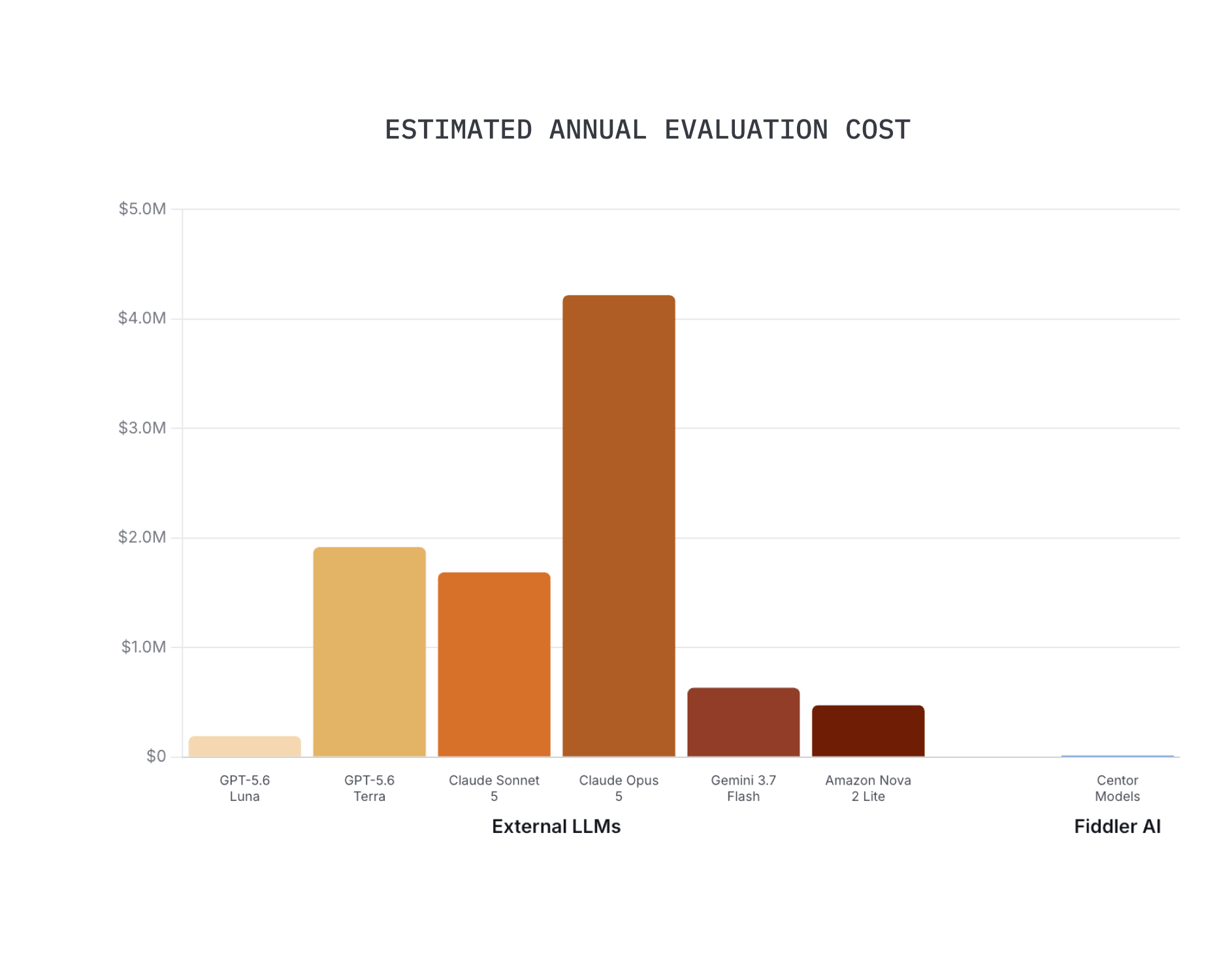
The Real Cost of AI Observability
Most AI observability platforms rely on external LLMs for evaluation and scoring. Using external LLMs you face:
Risk Gaps: Down-sampling means you could miss the events that matter most, creating governance risks.
Operational Overhead: Without built-in models, the evaluation burden falls on your team to own hosting, model selection, calibration, and prompt versioning.
The Evals Trust Tax: Every metric you evaluate adds to your total cost of ownership and the trust tax grows as your evaluation needs expand.
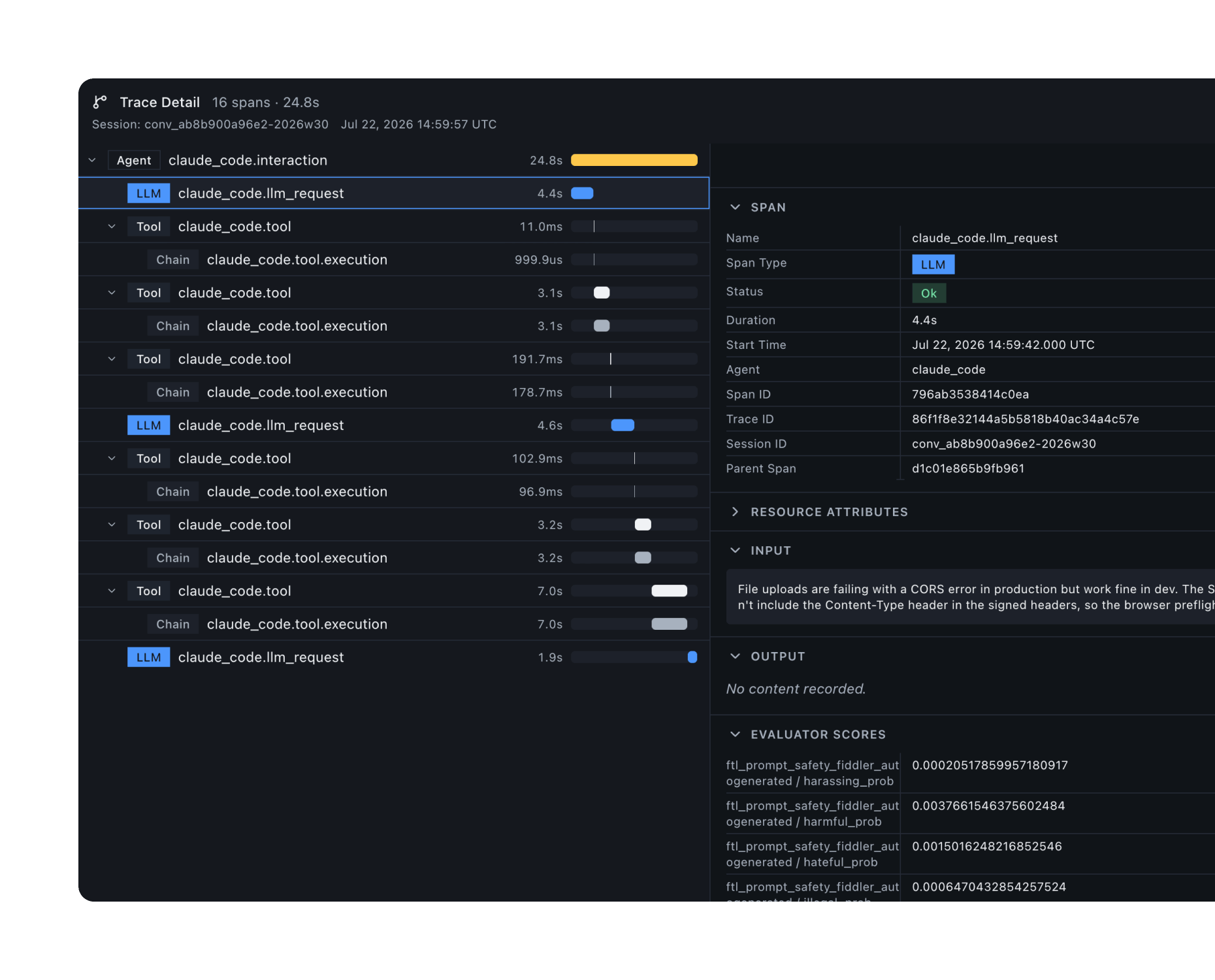
Built for Multi-Agent Systems at Scale
Span-level traces and manual root cause analysis can't keep pace with the complexity of multi-agent systems at scale.
Full, hierarchical visibility across from session to agent to trace to span.
Automated RCA with full decision context across the agentic hierarchy.
Purpose-built for global conglomerate scale of 30 million+ events per day.
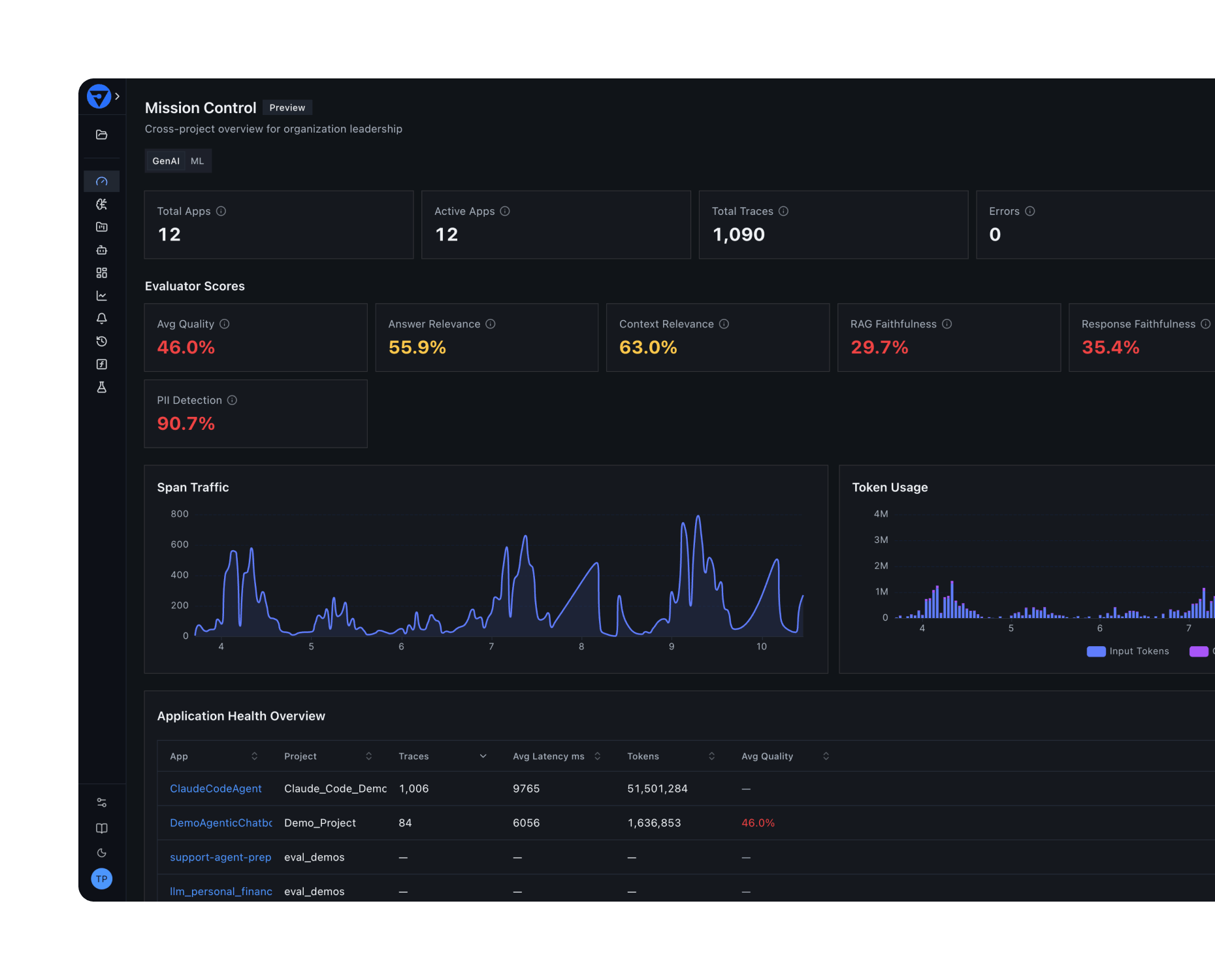
Enterprise-Ready Governance, Risk Management, and Compliance (GRC)
Fiddler provides a single pane of glass across your entire AI portfolio, with centralized governance, complete audit evidence, and executive oversight.
Generate audit evidence aligned with GDPR, HIPAA, NAIC, SR 11-7, and other regulatory requirements.
Manage all agents from a unified executive dashboard connecting AI behavior and performance to business KPIs.
Record every decision, action, and policy outcome with full traceability.
Don’t just watch AI. Start controlling and governing it.
Fiddler vs. Arize
Span-level traces tell you what a model produced. They don't tell you why an agent made a specific decision, how a failure propagated across a multi-agent session, or where in the agentic hierarchy a problem originated.
Step function, flat as you scale
Linear, climbs with every evaluation
Fiddler Centor Models
External LLM calls (data leaves environment)
Inline, in under 80ms
Alerts after the fact
Automated across the agentic journey
Manual trace and span review
AI registry, audit evidence, enforceable policy
Logs
One platform for executive and developer view
Developer view
Why Our Customers Prefer Fiddler


Proven in Production
Answering Your Comparison Questions
Have other questions? Reach out and our team will be happy to help.
How does Fiddler evaluate AI applications differently from Arize?
Arize evaluates by calling out to an external LLM for every metric, which means every evaluation adds an API cost that grows as you add agents. Fiddler uses Fiddler Centor Models to run evaluation in your environment, no external API calls, at under 80ms, so evaluation cost doesn't climb with usage.
What happens to evaluation costs when we're processing millions of traces with Fiddler vs. Arize?
With Arize, cost grows linearly, every trace evaluated means another external LLM call, so cost climbs in direct proportion to volume with no ceiling. With Fiddler, cost follows a step function instead: it moves in discrete jumps tied to infrastructure capacity, not a charge per evaluation. As deployment size grows, that gap compounds, Arize's linear cost keeps climbing while Fiddler's stays flat between steps.
How does Fiddler's governance and audit trail compare to Arize?
Arize gives you logs and dashboards, not governance. Fiddler adds an AI registry, audit evidence, and enforceable policy across the agent lifecycle, so you have a defensible record for a board, an auditor, or a regulator, not just a monitoring view.
Can Fiddler actually stop an unsafe AI action, or does it just alert us after it happens?
It stops it. Fiddler's runtime guardrails sit in the request-response path, catching unsafe input and wrong information before it ever reaches the model, and catching unsafe output before it reaches the end user, all in under 80ms. That's the core difference from alert-after-the-fact monitoring.
Is observability across ML and agentic systems enough to manage our AI at scale?
No. Arize can observe both ML and agentic systems. However, the key consideration is what happens after observability. Arize has no agent registry, no built-in guardrails, and no governance layer. Fiddler has all three, so you're not just watching your AI systems, you're managing, controlling, and governing them.
Does Arize offer anything for coding agents?
Arize can trace coding agent activity after the fact, showing you what an agent produced. What it doesn't do is enforce policy or control what an agent is allowed to do while it's working, at the IDE, CLI, or MCP boundary, in real time. Fiddler does both: it observes coding agents and governs them, blocking or flagging unsafe actions as they happen, not just showing you the trace afterward.
What should we be checking for when comparing AI observability platforms for agentic systems?
Can it control and enforce agent behavior, not just detect it? Does it act inline, or only alert after the fact? Does it require new infrastructure, or plug into what you already run? Does it capture every trace, or only sample to keep costs down, and miss the failures that matter most? And does one policy cover your whole agent fleet, first-party, third-party, and coding agents alike, or just a single vendor's agents?
Does Fiddler integrate with the tools we're already using?
Yes. It's model-agnostic (Azure OpenAI, Amazon Bedrock, and 100+ others) and framework-agnostic (LangGraph, CrewAI, AWS Strands), with OTEL-compatible telemetry, so it fits into the stack you already run rather than requiring a rebuild.
Where does our AI data live, and can we keep sensitive data inside our environment?
Fiddler runs single-tenant SaaS or self-hosted in your own AWS, GCP, or Azure account, so your infrastructure stays where you want it. The bigger question is what happens when a trace gets evaluated. Arize's evaluations call out to an external LLM, so that data leaves your environment every time, PII, PHI, and all. Fiddler Centor Models evaluate in-environment with zero data egress, so your sensitive data never has to leave to get scored.
Can Fiddler handle the volume of AI traffic we're processing in production?
Yes. Fiddler is built for enterprise scale, the kind a Fortune 20 company runs at, and we work with each customer to match deployment to their actual production volume. That volume doesn't turn into a runaway bill either. Fiddler's evaluation cost follows a step function, not a straight line, so scaling up doesn't mean an ever-climbing cost per trace the way it does with Arize's external LLM calls.
What security and compliance capabilities does Fiddler have?
Fiddler is SOC 2 Type 2 and HIPAA-ready, the same baseline most platforms in this space carry at this point. But certification is one side of the coin. Even certified vendors like Arize send your data to external foundation models every time they run an evaluation, and that's on top of what an agent can expose on its own through tool calls and decisions made in the moment. Certifications don't cover that risk. Enforcement does. Fiddler Centor Models evaluate in-environment, so that external exposure doesn't happen in the first place, and runtime guardrails catch and redact any PII or PHI before it reaches a user, in under 80ms.
We're in a regulated industry. Will Fiddler hold up at our scale?
Yes. Fiddler runs inside Fortune 100 companies across financial services, healthcare, and insurance, including a Fortune 20 company, the same regulatory bar you're operating under. It's SOC 2 Type 2 and HIPAA-ready, but the part that actually matters in an audit is the trail behind it. Fiddler gives you an AI registry and audit evidence across the agent lifecycle, so when a regulator asks what happened and why, you have an answer, not just a dashboard.
If we're already using Arize, why would we switch to Fiddler?
Arize offers observability and evaluation. It shows you what an agent did, but it can't govern what happens next, control it in the moment, or hold up to an audit. Fiddler does all three.
Where Arize gives you a dashboard, Fiddler gives you a control plane that runs from executive oversight down to developer workflows, so the same governance covers your entire agent fleet, not just one team's view into it. That governance holds up because it acts instead of just watching. Runtime guardrails catch unsafe input and output before either reaches the model or your end users, in under 80ms, rather than alerting you after the fact. And when something does go wrong, Fiddler gets you to the root cause automatically, instead of leaving your team to dig through traces and spans looking for it.
None of that gets more expensive as you scale, either. Fiddler's evaluation cost follows a step function, not a straight line, so adding agents doesn't mean adding cost the way it does with Arize's external LLM calls. That matters even more now that Arize is being acquired by Dynatrace, since its roadmap and engineering time will start competing with every other product line inside a much bigger company, not just serving what its own customers need.
Can Fiddler replace Arize, or would we use them together?
You can run them together. But splitting telemetry across two platforms means splitting your source of truth too, and governance is only as good as the data behind it. When one platform owns all the telemetry, monitoring and enforcement work off the same accurate picture, which is what makes the governance on top of it accurate as well.
Fiddler standardizes that picture across frameworks, too. Its semantic mapping takes the different concepts each telemetry framework uses, whether that's OpenTelemetry, OpenInference, Vercel AI SDK, or others, and maps them to one standard model. That's what keeps monitoring, enforcement, and governance consistent no matter which framework built the agent.
Get a Demo of Fiddler
See every action. Understand every decision. Control every outcome.
