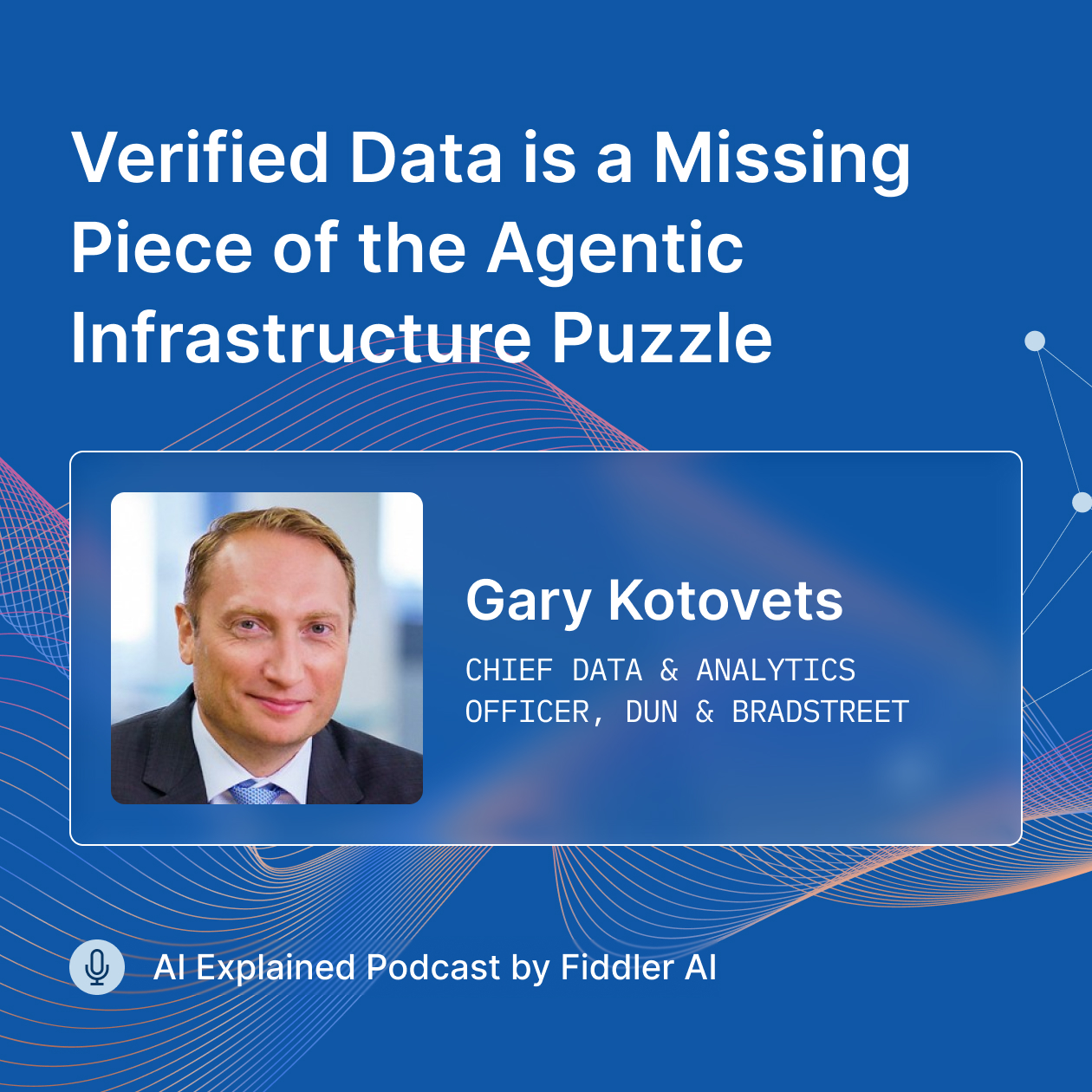
Verified Data is the Missing Piece of Agentic Infrastructure With Gary Kotovets
In this episode of AI Explained, we are joined by Gary Kotovets, Chief Data & Analytics Officer at Dun & Bradstreet, where he leads data, analytics, and AI strategy across the company's commercial graph of 650-plus million businesses. Before this role, he spent nearly two decades at Bloomberg as global head of data acquisition and management, building the rigor around data quality that now shapes how he thinks about agentic AI.
Gary breaks down what it takes to make enterprise data agent-ready — lineage and provenance, roughly 100 billion data quality checks run against source data, and a strict internal policy that every AI-generated answer must be able to show where it came from. He and Krishna dig into why hallucination is a model problem rather than a data problem at D&B, how a shared tools library with built-in rules keeps agents from drifting off script as workflows move from single-turn chat to multi-step autonomous tasks, and where governance, small language models, and agent-to-agent interactions are headed over the next few years. They close with a rapid-fire round covering data versus models, RAG versus fine-tuning, and the most overhyped and underrated ideas in enterprise AI right now.


Introductions
[00:00:06] Krishna Gade: Welcome and thank you for joining us on today's AI Explained. I'm Krishna Gade. I'm one of Co-founder and CEO of Fiddler AI. I will be your host today.
[00:00:16] We have a very special guest today. Uh, Gary Kotovets is the Chief Data and Analytics Officer at Dun & Bradstreet, where he leads the company's data and AI strategy. Uh, before joining D&B, he spent nearly two decades at Bloomberg as the global head of data acquisition and management.
[00:00:35] Um, you know, welcome, Gary. Um, you know, we're very excited to host you on this webinar.
[00:00:44] Gary Kotovets: Oh, hi. Hi, Krishna. Nice to meet you.
[00:00:46] Krishna Gade: Awesome.
[00:00:46] Gary Kotovets: Thanks for having me.
[00:00:48] Krishna Gade: Absolutely.
[00:00:48] Gary Kotovets: Hello, everybody
[00:00:51] Krishna Gade: Awesome. Gary, before we get into it, right, uh, tell us a little bit about who you are and what you're focused on at D- D&B. Um, you know, it'd be great to learn- Yeah
[00:01:00] about your background.
[00:01:01] Gary Kotovets: Yeah. Yeah, absolutely. Uh, so, um, I lead, uh, our data analytics and AI strategy. Um, and, uh, you know, the, the data that we're responsible for is essentially all of our commercial data and what we call right now our commercial graph. Uh, so this is data across, uh, uh, 650-plus million businesses, uh, that we, um, uh, uh, acquire information on and manage on a, on a basically daily and intraday basis.
[00:01:36] Uh, we collect over 11,000 different, uh, data elements or fields, uh, of information o- on any one of those businesses at any point in time across 200-plus, uh, markets globally. Um, and then we produce, uh, you know, analytics and insights, and a lot of people, I'm sure, are familiar with some of our, um, capabilities, uh, such as our Paydex score or, or failure delinquency scores, which basically give you a, a sort of a financial stability insight.
[00:02:05] Uh, uh, our supply chain analytics, our sales and marketing insights. Um, and then, you know, we serve, uh, the global, uh, I would say 95% of the Global 500, uh, corporates and financial institutions in the world. It's about 200,000 customers.
[00:02:22] Krishna Gade: Awesome. You spent almost two decades at Bloomberg. Um, you know, two companies where data is the entire product, right?
[00:02:30] How did that shape the way you think about AI and, you know, and, you know, build on especially on top of verified data?
[00:02:36] Gary Kotovets: Yeah. Um, you know, if you, if you think about the data that, uh, Bloomberg provides to its customers, um, it's, uh, you know, millisecond, uh, you know, high frequency, extremely sensitive content, right?
[00:02:52] So you're talking about exchange, uh, pricing, uh, right, real-time pricing, or you're talking about, uh, bond pricing from banks or, or whether it's, uh, index data from, uh, you know, MSCI or, or S&P that, uh, that you use to, uh, benchmark your portfolio against and make some of the most, you know, critical financial decisions as a, as a hedge fund or a large pension fund.
[00:03:18] Uh, and so the criticality and the sensitivity, uh, and the quality of the data, right, is extremely important for those customers, right? And I think that kind of, um- Uh, uh, you know, I guess, uh, the perspective, right, uh, on data and, and that kind of, I would say constant, uh, uh, it's almost like embedded in my blood at this point, right?
[00:03:46] Uh, to ensure that, uh, the-- our customers get the highest quality, uh, content, uh, because it's so sensitive, because their jobs are so sensitive to the quality of the information that they receive and the decisions that they make. And so this is very similar if you think about now from an agentic perspective.
[00:04:03] Um, you know, as, as more and more customers, uh, start to implement, uh, and, and, you know, orchestrate AI workflows, uh, AI-driven workflows that are becoming more and more autonomous and the decisions that are being made, uh, with, uh, you know, less and less humans in, in, in the middle. They have to trust the decisions those agents, uh, uh, make inside those workflows.
[00:04:30] And, uh, looking at the data and relying on the quality data is, is the most important critical step in that deci- in that process or in that design process, right? So, uh, you know, the way we think about D&B data, uh, is very much through that lens, right? Is, is, is saying we want the customer to be able to, you know, improve their productivity, improve their efficiencies, right?
[00:04:58] And we want to improve time to value for them to get that, uh, value out of their R- uh, AI investment. And so, uh, you know, our job is to ensure that we give them the, the, the best, uh, quality and the-- to serve as that foundation so they can start their journey and, and build their capabilities as quickly as possible
Building the Foundation for Agentic AI
[00:05:19] Krishna Gade: Awesome.
[00:05:20] I think, uh, you mentioned two things, right? Agentic trust and data quality. Um, D&B's data already lives in these enterprise workflows, you know, long before agentic AI, AI was a thing. Yeah. And now when you're starting to build agents, you know, on top of your data sets, you know, what, what are the foundational elements that you're putting together to make this change happen?
[00:05:42] Gary Kotovets: Uh, so, well, you know, we have, um... There's sort of, kind of multiple dimensions to this. Uh, one is you have customers who already embed our data into their, like you said, right, into their risk applications, into their, uh, procurement applications like SAP or into their CRMs, right? So the, the data is already living there, right?
[00:06:10] Uh, however, one of the key aspects as we all know, right, as part of that, uh, sort of AI development journey, you need the context, right? And so how do you become that context layer? And so we had to, uh, uh, you know, ensure that our data is available via MCP, right? Uh, we've created a lot of, uh, you know, skills and tools, uh, that, uh, help, that are available in sort of, uh, as a markdown file for our customers, and that allows them to quickly adapt our, our, our data and capabilities for those agents that are already sitting inside, uh, those CRM, for example, or is already interacting with their first party data.
[00:06:53] Uh, it may be sitting in their Databricks environment, right, along with their data, or maybe sitting in their, um, you know, or they may be using, you know, Codex or Cursor to develop those capabilities, right? And as they're developing those agentic workflows, uh, they need access, access to, uh, our content in that, in a way that, uh, makes it, you know, obviously consumable, right, uh, by those, uh, agentic capabilities.
[00:07:19] So MCP is the way to do that. We've also released, uh, A2A as, as another, uh, way and, uh, you know, we, we have a, a business verification match agent that we made available, uh, to our customers, uh, that, that could allows them to easily find, uh, through that protocol on Google Marketplace, uh, our, our, our agents and then deploy them into their, uh, uh, workflows.
[00:07:45] Krishna Gade: Got it. So when you actually go back to that data quality, when you say verified data, what does that actually mean to build in practice? You know, where does it go beyond just having clean- Yeah ... data records? Yeah.
What Verified Data Really Means
[00:07:57] Gary Kotovets: Yeah. I mean, uh, we think about, uh, data lineage, uh, right, and provenance. Uh, and we think about, you know, ensuring that the sources from which we obtain the data, right, are verified and validated.
[00:08:14] And then we have, you know, several steps after that where we also ensure that the values that are, uh, you know, extracted from those sources, right, are accurate, timely, um, and, uum- consistent, right? Uh, and, you know, we, we probably do around 100 billion data quality checks on a monthly basis across that in our entire, uh, you know, all those refreshes that are coming in through our-
[00:08:44] Krishna Gade: Mm-hmm
[00:08:45] Gary Kotovets: Uh, through our data supply chain go through about 100 billion checks, uh, a day. So that's pretty significant, uh, right? I mean, and so, you know, we're continuously, uh, uh, tweaking and monitoring, tweaking and modifying the data quality rules, uh, as the changes, uh, to the data occur from the source, uh, to make sure that we're validating and, and ensuring that we're, we're, we're feeding to the customer the best data there is.
[00:09:13] That kind of goes back to that trust factor.
[00:09:15] Krishna Gade: Got it. And when you're building the agentic layer on these data sets, you know, whether it's for credit analysis or, you know- Mm-hmm ... compliance use cases, how do you make sure that there is full lineage behind those decisions, you know, when agents are acting on their own?
[00:09:29] Gary Kotovets: Yeah. Yeah. So o- our, I mean, right from the start, I mean, we started our AI journey probably in '23, uh, ish. Uh, you know, we built a platform, a centralized platform that allows us to build, uh, our, our capabil- our AI capabilities, uh, and, and deploy them, uh, quite rapidly. Uh, and as part of that platform, uh, we've, uh, incorporated the, all of the data entitlements and the controls, and that also allows us to then create...
[00:10:05] You know, that sort of followed with, um, or followed up with a, a, a clear, concise, I would say, pretty rigid policy that says anything anybody builds, uh, in our company, uh, has to be able to demonstrate where the answer came from.
[00:10:25] Krishna Gade: Hmm.
[00:10:26] Gary Kotovets: Um, and so that lineage is extremely critical, and it's embedded in all of our, uh, products today.
Tackling Hallucination & Non-Determinism
[00:10:33] Krishna Gade: Got it. Apart from lineage, you know, one of the problems that, uh, data companies like you might be dealing with is this non-determinism of agents, right? Where agents can hallucinate and, you know. You know, what-- how are you sort of, uh, addressing those problems? Is it a data problem or a model problem for you?
[00:10:51] Gary Kotovets: So it's definitely not a data problem- Mm-hmm ... because, uh, you know, it, it, we're, we, we are that grounded truth, right? Yeah. So it's been, it's been easier, I would say, for us and- Mm-hmm ... a lot of our customers because we're sort of serving up to you what you need to, uh, uh, we're serving up to you what you need to, um, you know, validate, right?
[00:11:14] Mm-hmm. Uh, against.
[00:11:15] Krishna Gade: Hmm.
[00:11:15] Gary Kotovets: Uh, so it really becomes ensuring that the model serves up the right answer.
[00:11:21] Krishna Gade: Right.
[00:11:21] Gary Kotovets: And so, you know, we, we've experiment a lot with many different, uh, small language models, large language models.
[00:11:29] Krishna Gade: Mm-hmm. Mm-hmm.
[00:11:30] Gary Kotovets: Uh, w- I mean, we literally have a continuous sort of pipeline- Mm-hmm ... through which we, once we identify something new- Mm-hmm
[00:11:37] right, that we should look at, open source or, or frontier, uh, version or new frontier model version, we automatically start to test validate it, and then-
[00:11:49] Krishna Gade: Mm-hmm ...
[00:11:49] Gary Kotovets: Figure out, you know, look at how it responds, right, uh, to the different data sets and how it serves them up to our customers. Yeah. And ex- and how it also executes agentic, you know, as agents execute those tasks, how are they executing them, and are they doing it the right way?
[00:12:04] So is there a problem- So you
[00:12:06] Krishna Gade: Probably are running, like, a lot of agentic evals as you're trying
[00:12:09] Gary Kotovets: To We do a lot of agentic evals, and then we also, and then we also, um- created monitoring capabilities, right? That watch for, uh, behavior. Right. That monitor for behaviors, right? So to ensure that the right steps were taken, uh, by the agent to produce that, uh, that answer.
[00:12:28] And so we run those, uh, periodically-
[00:12:31] Krishna Gade: Mm ... uh,
[00:12:32] Gary Kotovets: To, to ensure that everything is working the way as designed.
[00:12:36] Krishna Gade: Yeah. One of the things that we work with on our, our sales team, we work with some of these, uh, data companies like Nielsen. One of the things that we get reported is when agents query two trusted data sources, and then they, they start to disagree, you know, and then the agent is kind of conflicted.
[00:12:52] Have you run into some situations like that where, you know, anything that you can share, um, uh, to, to our audience? Yeah.
[00:12:58] Gary Kotovets: Yeah, I mean, yeah, that happens, uh, you know, occasionally- Mm ... uh, right, for us. Uh, obviously, you know, we also, uh, you know, we, we kind of pipe everything into the single source, but obviously there's tens of thousands of sources from which we collect our data.
[00:13:16] Krishna Gade: Right.
[00:13:16] Gary Kotovets: Uh, or, a- and/or produce it ourselves. And so yes, that does happen. You know, one of the things that we do is a little bit of that sort of what I just said. We have this sort of generic tools library-
[00:13:29] Krishna Gade: Yeah ...
[00:13:29] Gary Kotovets: It, that allows the agents to, uh, that has very rigid, uh, r- rules, right? Yeah. Embedded. And so when we, uh, uh, when anybody within the organization develops, uh, an, an agent they must follow or they must call out those tools, right?
[00:13:49] Mm. That we've developed. And those are the rules that ... Those are the tools that have the rules-
[00:13:53] Krishna Gade: Got it ... that
[00:13:54] Gary Kotovets: The specific rigid guidelines, uh, that enforce that, uh, those people to follow. So, uh, we, um, you know, we, we've seen still, right, uh, some agents kind of break those rules over time, right? Mm. Uh, but that's where some of that monitoring comes in, right?
[00:14:11] To make sure that, hey, like, you know, did they follow the same steps as, as, as they were designed to do or not?
[00:14:18] Krishna Gade: Yeah. So I mean, these days we are moving from single turn agents that were more chatbot-like to like multi-turn agents that are taking- Yeah ... more actions, right? Have you seen the change in how you're evaluating and monitoring agents as you probably going through that journey?
[00:14:35] Gary Kotovets: Yeah. I mean, yes. I mean, you know, we started ourselves, right? With, uh, we have our own sort of chat interface- Yeah ... that talks to all our data, right? And, uh, and interestingly, that also became p- in part our framework that we use now to, uh, develop all the other, uh, kind of agents that exec- you know, that, that develop, that execute tasks, right, uh, inside our particular workflow.
Multi-Agent Workflows in Practice
[00:14:57] Krishna Gade: Becomes your co-pilot somewhat,
[00:14:59] Gary Kotovets: Yeah. Yeah, yeah. And so yeah, there's, there's, you know, like our risk platform, for example, has, um- You know, uh, a KYC agent, right? Yeah. And a, and a credit check agent. And, uh, u- underneath that, there's other kind of sub-agents that perform the specific subtasks, right, that are required to, to do the full KYC check- Right
[00:15:24] on that customer, right? Um, or a, a, a sub-agent, uh, sub-agents that perform a full credit check-
[00:15:31] Krishna Gade: Mm ...
[00:15:31] Gary Kotovets: On a customer, right? Um, and, uh, and, and then, you know, once those two steps are done, then there's some kind of a, a decision that's then produced and, you know, the, the ... our customer then makes a decision, "Hey, I want to, you know, press the button," so to speak, right?
[00:15:47] To- Mm. To provide that, uh, uh, cust- that their customer with the loan, right? Yeah. Or reject it, right? And then eventually those steps would probably be automated as well, but we kind of leave it up to the client to make those final- Yeah ... step decisions, uh, themselves. Um, and so, uh, you know, th- those flows, right, follow, like as I mentioned, those kind of tools and skills that we've created.
[00:16:15] Krishna Gade: Right.
[00:16:15] Gary Kotovets: Uh, but they also follow the standard logic that we have already created inside the, our risk analytics software platform that we- Mm ... you know, already have a lot of customers using, right? So for those agents it's sort of dif- it's easier to follow a specific path-
[00:16:33] Krishna Gade: Mm ...
[00:16:34] Gary Kotovets: Uh, because those paths have been predetermined-
[00:16:37] Krishna Gade: Yeah
[00:16:37] Gary Kotovets: Uh, for them already, right? Uh-
[00:16:39] Krishna Gade: You're layering the agentic skin on your existing applications and taking- Yeah ... advantage of years of work that you
[00:16:44] Gary Kotovets: Already have. Yeah, yeah. So we recreated the agents actually to mimic-
[00:16:48] Krishna Gade: Ah, okay ...
[00:16:48] Gary Kotovets: The workflow of the software, right? That's
[00:16:50] Krishna Gade: Really cool. Yeah.
[00:16:51] Gary Kotovets: Yeah. And then that, those
[00:16:52] And then those, uh ... So it's the ... And, and then what we did was just, we just embedded the, the steps the, the, the software took-
[00:17:00] Krishna Gade: Uh-huh ...
[00:17:00] Gary Kotovets: When it did the analysis, right, o- o- of a KYC step or a, or a credit check step.
[00:17:06] Krishna Gade: And so they, the logic in those applications becomes like the, the checks and balances- The agent.
[00:17:11] Gary Kotovets: Yeah, exactly ... that's doing that work. The logic of those applications essentially become the prompts-
[00:17:15] Krishna Gade: Right ...
[00:17:15] Gary Kotovets: For the agents that we built, right? Yeah. And then, and then we, we made those prompts into these, what we call the skills, right? Uh-huh. And the skills are like there's a skill that does matching, right?
[00:17:28] Mm. So first let me verify that the entity you're questioning is the one that you intend to question, right, me about, right? Then let me then, uh, double check to give you here's the, you know, another skill that looks at photographic information and pulls that down, right, to give you the basic- like, knowledge that you need to know before you make that next step, right?
[00:17:51] Which is, okay, let me go and check, uh, beneficial ownership, uh, information. Let me go check corporate linkage and understand where that company belongs on that, uh, tree, right? Let me check the CEO name, right, and the corporate officers. Uh, let me do, um, uh, uh, you know, a, a check around physical locations of that business, right, and where they're
[00:18:15] You know, do they have any suppliers in, you know, geopolitically or i- in the climate risk, uh, zones, right? Things like that. So those are all-
[00:18:24] Krishna Gade: Yeah ...
[00:18:25] Gary Kotovets: Standard steps that our software took that are now- Mm ... you know, an agent does, performs.
[00:18:30] Krishna Gade: Mm,
[00:18:31] Gary Kotovets: Mm. Uh, and then the skills are those individual sort of micro tasks that we require the agent to, to go and get, right?
[00:18:39] A- and, and look up or interact with, rather.
[00:18:42] Krishna Gade: Awesome. That's really cool. So when, when, when you have so many of these, uh, s- agentic setup, like multi-agent systems, you know, agents and sub-agents coming together, you probably need a governance structure, right? So that covers all the- Yeah ... legal compliance, ethics, cybersecurity.
[00:18:57] Gary Kotovets: Yeah.
Governance, Ethics & Human Oversight
[00:18:57] Krishna Gade: Can you share more about how you're thinking about it? What have, what have you set up or?
[00:19:00] Gary Kotovets: Yeah, yeah. I mean, we, we, we, we established our, our governance la- uh, you know, framework, uh, right from the beginning, right? Mm-hmm. And, uh, you know, it starts with, uh, we call, you know, LCE, which is our legal compliance ethical, uh, right?
[00:19:18] And, uh, w- we, we, uh ... And then there's kind of the product and kind of technology overview, uh, steps or pieces. Uh, the legal compliance ethical goes through, you know, making sure we understand the, the terms and conditions of the models that we're using, uh, right? Uh, we understand the, the specific, uh, data privacy and data transfer rules, which we already know anyway, so those rules are kind of already embedded by default.
[00:19:47] Uh, we understand the, um, uh, you know, the ethical use of s- of some of those use cases and, and, and ensuring that, for example, PII data is protected and it's not going to the right places. So those things are very rigid for us and, and very, uh, robust, right? Uh, where we have, you know, people reviewing every model before we decide to deploy it, and then people reviewing every use case with the workflow before we decide to deploy it, and those are people from our legal team and our risk, uh, chief risk officer's team- Got it
[00:20:22] um, along with our technology and, uh, product groups.
[00:20:26] Krishna Gade: And where does humans remain in the loop? You know, where, you know, where, like when, as you move into more, you know, autonomous agents, is that, like, a risk decision or a regulatory decision, you know?
[00:20:37] Gary Kotovets: Yeah, I think it's all of those. Uh, you know, w- w- we- Allow you to dec- we, we let you make that decision on your own, right?
[00:20:47] Yeah. Uh, a- as you, you know, we can give you pre-canned, uh, workflows as I described- Mm-hmm ... uh, you know, to, for autonomous decisions.
[00:20:57] Krishna Gade: Yeah.
[00:20:57] Gary Kotovets: Uh, or, uh, or, or and, and even in those workflows you can insert yourself in any of the steps- Mm ... that, you know, we decided an agent could perform, right? Yeah. Uh, or you can sit all the way at, at the end and, and make that final decision, like I said, to issue credit or to onboard that supplier, uh, or to issue, you know, or send a, a, a marketing email to a particular customer, right?
[00:21:24] So we're, we're letting you do that final step yourselves. Yeah. Uh, but or we can help you automate it.
[00:21:30] Krishna Gade: Mm. Got it. So as you g- go on the agentic journey, as many companies are going on that there's this token maxing problem people are running to, right? Mm-hmm.
Small Language Models & Cost Savings
[00:21:40] Krishna Gade: Lot of interest right now in small language models as a way to drive down costs, you know.
[00:21:44] Gary Kotovets: Yeah.
[00:21:45] Krishna Gade: How has D&B approached this internally, you know?
[00:21:47] Gary Kotovets: Yeah. I mean, so we've, we've, uh, you know, as I mentioned, you know, we, we have sort of a- an ongoing pipeline of continuous sort of discovery and qualification of different models.
[00:21:58] Krishna Gade: Mm.
[00:21:59] Gary Kotovets: Uh, uh, small language models, open sourced, uh, small language models are definitely on our list.
[00:22:07] Uh, we've already deployed, uh, them at least, uh, across at least seven different, uh, use cases.
[00:22:12] Krishna Gade: Mm.
[00:22:13] Gary Kotovets: Um, and you know, we've seen literally, like 95, 97% reduction in token costs-
[00:22:22] Krishna Gade: Mm ...
[00:22:22] Gary Kotovets: For some of those tasks, uh, where we use them- Wow ... which is, uh, s- very significant.
[00:22:28] Krishna Gade: Yeah, yeah.
[00:22:28] Gary Kotovets: Not just that, I mean, it's also letting us improve, uh, dramatically the quality, uh- Yeah
[00:22:34] uh, or accuracy of the results, right? Because you've got sort of these small language models that are very focused, right? Uh, much more focused on specific, um, you know, steps, right? Or tasks-
[00:22:47] Krishna Gade: Yeah ...
[00:22:47] Gary Kotovets: They're performing and, and the results we've, we've seen are, are, are, uh, very significant. Like, we have one product that we released, we call it, uh, company summaries.
[00:22:57] Krishna Gade: Mm.
[00:22:58] Gary Kotovets: Um, and it's, it's very s- you would think it's very simple, uh, but it's actually, uh, you know, from a customer lens perspective, one of the most complex things, which is really understanding mu- on a much deeper level what does a company actually do for a living? Mm. So if you think about from an insurance underwriting perspective, that's a very in- that's a very difficult, uh, thing to understand.
[00:23:21] Customers are very, you know, it's self-reported-
[00:23:24] Krishna Gade: Mm ...
[00:23:24] Gary Kotovets: Usually, right? So, uh, you know, if you have a landscaping company that, uh, tells you that they do only... And they're supplying for workers' comp insurance, and they tell you that they do, um, uh, they only cut grass, right? Uh, and uh, the SIC codes and the industry codes that we provide you- Basically confirmed that that's a landscaping company, and that's all you need to know.
[00:23:50] What we've been able to do is look at the company sort of website plus the different other kind of sources of information that we can collect about that company. And then we use, uh, SLMs across the different tasks, of like identifying the data, the specific information across the different websites, pulling it down, uh, then, uh, filtering and prioritizing the information that's needed, uh, that is, you know, that's needed to be distilled down and trans- translated, so to speak.
[00:24:21] Mm. And then we feed it into a, a, a large language model.
[00:24:24] Krishna Gade: Mm.
[00:24:25] Gary Kotovets: And that creates a much deeper insight into that company. And so in the example of the landscaping company, we were able to also decipher that they also do tree pruning.
[00:24:35] Krishna Gade: Ah,
[00:24:36] Gary Kotovets: Interesting. Right? And that gives you a very different, obviously, workers' comp insurance premium than than just cutting grass.
[00:24:41] Krishna Gade: Very
[00:24:42] Gary Kotovets: Cool. Very cool. We have a lot of insurance companies that are very interested in that kind of a capability. And then, and, uh, like I said, the production of that, uh, summarization went down by 95% as a result of use of the, uh, small language models.
[00:24:56] Krishna Gade: And this is where like, you know, models and LLMs can actually help beyond just simple rules, right?
[00:25:01] Because they can explore- Yeah ... the whole related concept space.
[00:25:03] Gary Kotovets: Exactly. Exactly. And that's, that's what's amazing about this technology, right? It's like, you know, you, you, you, you continuously discover, you know, a lot, you know, a lot of new things that you would never have thought, even for customers never have thought that they would be even interested in.
[00:25:20] And then we, you know, we created it and then it's like, oh my God, that's all, it's all we needed, right? It's like the hottest selling product.
[00:25:27] Krishna Gade: Awesome. That's amazing. So what is the, you know, practical difference in compute cost between grounding agents in a verified deterministic data source versus sending out to, uh, to collect open information on the web?
[00:25:40] You know, what does that look like-
[00:25:41] Gary Kotovets: Yeah ...
[00:25:41] Krishna Gade: in this for you?
[00:25:42] Gary Kotovets: So we've seen that, uh, you know, as, uh, as we think of, as you think about, uh- You know, Dun & Bradstreet basically creating, uh, uh, pre-calculated answers, right? Uh, so if you think about, I don't know, a credit score that I just mentioned, right? Or a corporate hierarchy, uh, that is predetermined that, you know, where we verify that this company is a subsidiary of this other company-
[00:26:10] Krishna Gade: Mm.
[00:26:11] Gary Kotovets: Right? That kind of deterministic answers, so to speak, right, uh, are, you know, are extremely efficient when you talk a- when you think about, you know, agentic, uh, agents that would have to otherwise go on the web, you know, scrape the web, understand the different companies that are relevant to this company, figure out how they belong to each other on the tree or, or actually if you're asking, uh, you know, for, uh, an agent to perform a risk assessment, uh, right, just based on, you know, loosely available information that's, that's out there and having it connect the dots together and produce the answer.
[00:26:52] So just logically, right, the reduction in costs would be, you know, quite significant, right? And, and so w- we've seen the ranges. I mean, they're, you know, anything from like 50 to 70 to 80% savings- Mm ... in terms of token costs because you already have the answer served up to you. You don't need the agent to do the compute, to perform the compute to calculate it.
[00:27:13] Krishna Gade: Awesome. Let's take some audience questions.
Risk, Regulation & Data Provenance
[00:27:16] Krishna Gade: There is a related question here from Sridhar. Uh, what are the most significant risks enterprises face in proving provenance and lawful acquisition of data used by AI systems while also complying with rapidly evolving AI regulations across the US and globally?
[00:27:33] Gary Kotovets: Yeah, so that's a big question. Uh, I think that, um the d- it, it depends on the size of the enterprise- Yeah ... uh, obviously, right? Uh, but the risks, uh, you know, are, are ... The risks are very much evolving, right? Right. So if you think about, um, the systems of record, legacy systems of record i- in a bank, right, uh, that are so, like, dispersed across the organization, um, y- y- you have a lot of companies, a lot of those large organizations, uh, under the pressure of their CEO saying, "We must go AI," right?
[00:28:17] Are all running super fast towards- Yeah ... deployment, right? And then they s- have to rapidly stop because they realize that they have to first figure out what's in those systems of record, right? A- and then they have to decipher what's PII, what's, uh, what's not, right? Then it's like, once they figured that out, then they have to extract that.
[00:28:41] Uh, they then have to standardize it in some way, right? Mm. Uh, to make it AI ready or, you know, consumable, right? Uh, then they have to make sure that it follows all the, uh, you know, data residency rules, and it follows the ... And then you also have to figure out if you're deploying the right model, right? Yeah.
[00:29:00] Like the model itself, whether you're open source model from China or you're using a, a, a, you know, a, a, an open source model from US. I mean, all those things have to be, uh, ver- verified, validated. Uh, and so the job is quite significant, right? Mm-hmm. And the risks are there, right? And then on top of that, once you deploy, you then have to make sure you're monitoring to, to understand that things are not being done by these agents that you haven't authorized them to do, right?
[00:29:31] So you have to create a lot of this entitlement layers and risk management layers to make sure that you, you, you, uh, you know, create like rigid, rigid controls around these things.
[00:29:43] Krishna Gade: Yeah, absolutely.
[00:29:43] Gary Kotovets: Um, so there's a lot of, there's a lot of work there, I think.
[00:29:46] Krishna Gade: Yeah. We call it like the sandwich situation between the FOMO and the FOMO.
[00:29:51] You know, everyone has-
[00:29:51] Gary Kotovets: Yes, yes ...
[00:29:52] Krishna Gade: FOMO AI and the FOMO- Yeah ... is the fear of messing up, you know? And, and that-
[00:29:56] Gary Kotovets: Yeah. Yes, exactly ... every
[00:29:57] Krishna Gade: enterprise AI leader is facing right now. So when it comes to D&B, um, are you, like, sort of looking at, like, NAIC and EU AI Act and all of these regulations closely? You know, how do you think about the, like, regulatory landscape evolving, you know?
[00:30:12] Gary Kotovets: Oh my God. Yeah. I mean, if you talk to our chief risk, uh, chief compliance officer, you know, she's gonna ... She monitors how many new regulations she reviews on, like, a, you know, quarterly basis, right? Yeah, yeah. Uh, and so what we've done is we, we, you know, we have kind of a forward-looking ... Like, she does all the pre-work-
[00:30:33] Krishna Gade: Yeah
[00:30:34] Gary Kotovets: Uh, for us, uh, not just what's out there already and been established, but what's been, what's also coming,
[00:30:41] Krishna Gade: right?
[00:30:42] Gary Kotovets: Yeah. And then so also what's, like, kind of horizon three, what, what may be coming, right? Right. At some point because there are rumors and whispers about it, right? And, and, uh, and that, uh... So I'm kind of answering more generically, right?
[00:30:54] You know, and, and that, uh, pipe of that sort of view that they provide us-
[00:31:00] Krishna Gade: Yeah ...
[00:31:00] Gary Kotovets: Allows us to then build, uh, and design things in accordance, right? Uh, to make sure that we're accommodating for all those different, you know, changes.
[00:31:11] Krishna Gade: Yeah. One of the things that is on the rise right now is this multi-agent setups, right?
[00:31:15] So where agents can communicate with other agents, A2A protocols, MCP, you know, these are all... So when you are seeing, uh, you know, multi-agent setups, when systems from different vendors hand off each other-
[00:31:26] Gary Kotovets: Mm-hmm ...
[00:31:26] Krishna Gade: how do you keep data verification intact across the whole chain?
[00:31:30] Gary Kotovets: Yeah. So there's a, there's, kind of, a few things.
[00:31:33] You know, there is, uh... You know, we, we built this, uh, um- Our match and business verification agent- Mm. Right? That kind of goes horizontally, right? Mm. Uh, we think about that as almost like a digital handshake between the different vendor, uh, between the different agents.
[00:31:55] Krishna Gade: Mm.
[00:31:55] Gary Kotovets: So as agent, you know, one performs a particular task, uh, on a particular entity, right?
[00:32:02] It can then call out, uh, uh, and it passes that task over to the next agent.
[00:32:09] Krishna Gade: Mm.
[00:32:09] Gary Kotovets: Right? That next agent can call out our, our entity verification agent basically match or business verification- Mm ... to make sure that it's still talking about the same entity, right? Mm. Mm. It's still performing the task of the same entity.
[00:32:23] Krishna Gade: Mm.
[00:32:23] Gary Kotovets: So I, I... That's definitely, uh, an area that, uh, is, you know, we've seen people, you know, kind of incorporate these, these, uh, common, I would say common components- Mm ... right, into their workflows, right? Mm-hmm. Um, but we've also of course seen, you know, a lot of customers, and we, we think about it as well a lot, right?
[00:32:46] Is how do you verify the agents themselves-
[00:32:48] Krishna Gade: Yeah ...
[00:32:49] Gary Kotovets: And make sure that they belong to the ent- to the business, this is the they, uh, you know, say they belong to, right? Yeah. Because especially if you're not sitting in the same company and you're not orches- you didn't orchestrate a multi-agent, uh, you know, workflow yourself, your interact- your agent is interacting with some third party agent that's sitting on, on with a counterparty on the other side.
[00:33:14] That needs to be verified as well, right? So that, that the verification and the, the, the trust between two, the two agents has to be verified as well, right? So there's something there as well that we're also looking at, and- Yeah ... um, making sure that we're accommodating for that trust and making sure that they trust each other before the, the, the, the job is done.
[00:33:36] Krishna Gade: Yeah. And also, like, uh, data staleness could be an issue as well, right? When an agent pulls data is an anonymous question as well here. When agent- Oh, yeah ... when agent pulls data from an outdated data source, how do you catch it before it affects, like, its output? Yeah. And then it passes on to another agent, you know, downstream.
[00:33:53] Yeah.
[00:33:53] Gary Kotovets: Yeah. I mean, that's, uh, that's a, that's a difficult one. Um- You know, to, to, uh, kind of capture beforehand, right? Mm-hmm. I, I think, you know, it kind of goes a little bit back to the monitoring for your agentic ... for the agent behavior- Yeah ... uh, making sure they follow the right steps, right? Uh, and then periodically checking in if the outputs are, are the same.
[00:34:18] Uh, you know, we have also put a kind of a, a more robust program around, um, if somebody changes something upstream, uh, in our data, you know, supply chain, right? Mm-hmm. That has to be communicated and, and there's all kinds of, you know, operational processes in place to make sure that the, the, you know, that that information gets captured.
[00:34:44] So-
[00:34:44] Krishna Gade: Got it. And does, does that imply more into the data security and kind of, you know, what controls that you put in place when- Yeah, it's- ... all data sources? Yeah.
[00:34:52] Gary Kotovets: Yeah, it's part of that.
[00:34:54] Krishna Gade: Mm-hmm.
[00:34:54] Gary Kotovets: It's part of that. But, you know, it's, it's on stream because we have to monitor for, like you said, still, you know, quality- Right
[00:35:00] accuracy, you know, timeliness, things like that.
[00:35:03] Krishna Gade: Got it. And, and I think there's a related question as well around the variance of AI models, and you mentioned you're using a collection of small models and big models. Kenneth fra- uh, from our audience is asking, "How do you manage the variances of AI models and the versions as they, that are used as they progress?
[00:35:20] Do you upgrade or change models? And how do you handle backup or continuity of services if there are security breaches or natural disaster interruptions?"
[00:35:29] Gary Kotovets: Yeah. So we manage ... So, you know, we have a bit of a controlled environment- Mm-hmm ... uh, where we don't just- Give everything to everybody-
[00:35:40] Krishna Gade: Mm ...
[00:35:40] Gary Kotovets: Right? You know, it goes through a vetting process-
[00:35:44] Krishna Gade: Mm
[00:35:44] Gary Kotovets: Um, you know, where they're tested and validated-
[00:35:48] Krishna Gade: Mm ...
[00:35:49] Gary Kotovets: And then deployed, right? Mm. And then we go through those, you know, we re-review what we've tested and validated and deployed- Yeah ... right, uh, back. Uh, and, uh, we are also able to swap out models quite- Mm ... quickly, uh, between one another.
[00:36:09] Krishna Gade: Mm.
[00:36:09] Gary Kotovets: And, uh, you know, in some cases we have, depending on the criticality of the case-
[00:36:15] Krishna Gade: Mm
[00:36:15] Gary Kotovets: Uh, use case, we, uh, almost have backup models- Mm ... right, uh, that we have already tested and know that they can perform relatively similar to the model that we just deployed for this use case.
[00:36:28] Krishna Gade: Mm.
[00:36:28] Gary Kotovets: Um, so and then, you know, of course, if you think about, uh, you know, uh, open source models, where they're coming from, right?
[00:36:39] There's the whole kind of, uh, conversation about and the whole idea around on-prem and making sure- Yeah ... we're me- you know, we have a... It's containerized.
[00:36:50] Krishna Gade: Mm.
[00:36:50] Gary Kotovets: Um, and, uh, you know, to make sure where there's no sort of leakages.
[00:36:55] Krishna Gade: Right.
[00:36:56] Gary Kotovets: Yeah.
[00:36:57] Krishna Gade: So this is an interesting question, right? You know, foundation model labs out there, you know, buying data sets, you know, kind of outgrowing their sort of, uh, frontier.
[00:37:05] And D&B seems to have made a call that, you know, your data is not allowed to be used to, for model training. How do you think- Yeah ... about where the line should be? You know, what should enterprises be asking themselves before they make a decision around, like, giving the data for model training?
Model Training & the Future
[00:37:19] Gary Kotovets: Yeah. I mean, yeah, so, you know, obviously, you know, training...
[00:37:24] First of all, training is, is a, uh, often misunderstood, uh, you know, word, right? Yeah. Uh, if you talk to our customer lawyers and, uh, they will say, "We want training rights."
[00:37:40] Krishna Gade: Mm-hmm.
[00:37:42] Gary Kotovets: And then when you talk to the business people, and then you talk to the technical people, actually they don't want training, right?
[00:37:46] They actually just want RAG, and it's just another variation of this. Yeah. So majority of our customers don't actually ask us for training even- Yeah ... you know, even after we say no, they still don't ask us, right? Yeah. It's the lawyers who typically do and then fight with us.
[00:37:59] Krishna Gade: Yeah.
[00:38:00] Gary Kotovets: Um, but that said, right, it's still a, it's still a difficult, uh...
[00:38:05] obviously, you know, for a data provider, that is, this is our bread and butter, right?
[00:38:09] Krishna Gade: Mm-hmm.
[00:38:10] Gary Kotovets: And so, you know, we, we, we've, um, never had a case where we let anybody train, right? Mm-hmm. Uh, but if we, if we would, and if anybody really, really, really wants it and they really, really mean it-
[00:38:25] Krishna Gade: Mm-hmm ...
[00:38:25] Gary Kotovets: Right? There, there are ways to containerize this, right?
[00:38:29] Mm-hmm. And, and still allow us to retain some control-
[00:38:33] Krishna Gade: Mm-hmm ...
[00:38:33] Gary Kotovets: Uh, of the data of the model that's trained- Yeah ... on that data, right? And so there is ways to do that without having to completely... You know, so if we have enough control like that- Mm-hmm ... right? Hey, we put it in a, in a, in a, in a, um, in a container, right?
[00:38:50] It's, it's, uh, you know, like a data room type of, uh, right, uh, uh, environment. Uh, we have control. You have control. Nobody else has control. We have control of the model.
[00:39:01] Krishna Gade: Yeah.
[00:39:01] Gary Kotovets: You know, we can pull the plug, right? Mm-hmm. If we feel like there's something is happening that is impacting our, our business.
[00:39:09] Krishna Gade: Got it.
[00:39:09] So you're investing a lot on the small lang- language model training and development on, on your proprietary models.
[00:39:14] Gary Kotovets: Yes, yes. Yes, we're doing that. Yeah.
[00:39:16] Krishna Gade: Makes sense. So models themselves are, im- improving incredibly quickly, right? So what, you know, when you kind of step back a little bit, what part of the enterprise AI stack do you think that will actually become more important as models get commoditized, and everyone has roughly the same kind of models across the board, open weights, closed weights?
[00:39:34] Gary Kotovets: Yeah, yeah. Well, I'm gonna give you the biased and the non-biased answer, right? Uh, you know, we think about obviously, you know, the data, right? Mm-hmm. That context layer-
[00:39:46] Krishna Gade: Mm-hmm ...
[00:39:46] Gary Kotovets: Right, we, we think will become the, the, the, the... will become that val- most valuable, uh, component, right? Yeah. I, I also think there's the, the workflows, right?
[00:39:59] Mm-hmm. I think there's, there is that aspect of, um- Uh, uh, you know, there, you have to be a subject matter expert, and you have to know the data that you're dealing with to be able to write the best agent to interact with that data, right? Yeah. And, and give you the best results.
[00:40:19] Krishna Gade: Mm-hmm.
[00:40:19] Gary Kotovets: Uh, but I also think that, so that whole sort of idea around, you know, verification and, and validation and, and, uh, grounding and-
[00:40:30] Krishna Gade: Mm-hmm
[00:40:31] Gary Kotovets: Of the workflow, right? Or verification of the workflow, validation of the workflow, making sure that the agent is performing the right tasks, right? I think those types of things, you know, will become more and more, uh, critical, right? Mm-hmm. And, and there may be f- you know, not a lot of those kind of providers that can help understand that.
[00:40:50] And, you know, it... And it's some combination of the data provider-
[00:40:53] Krishna Gade: Mm-hmm ...
[00:40:54] Gary Kotovets: Making sure that, yes, it pulled the right information, it executed on the right information.
[00:40:58] Krishna Gade: Mm-hmm.
[00:40:59] Gary Kotovets: Right? And then the technology provider who can give you that additional layer of insight that, that says, "Yes, you know, that task was done correctly," b- based on the subject matter expert that designed it.
[00:41:11] Krishna Gade: Yeah, yeah. We call it, like, the three Cs, the context, the control, and then once you have context and control, you can compound on the AI.
[00:41:17] Gary Kotovets: Yeah. There you go. Exactly. Exactly. You said it better than I did. No,
[00:41:21] Krishna Gade: it's, it's great. Yeah. So I guess there is a, you know, most of, uh, companies have a lot of their enterprise data.
[00:41:27] They may have legacy data infrastructure. There's an audience question as well. You know, that's probably not yet built for AI agents. You know, even, you know, given your experience of, you know, where you have come from and where you've done so far, what you've done so far on agentic AI, what do you advise them to start?
[00:41:43] You know, where, you know, where do you... Where, where can they start, you know, on this agentic journey, uh, to layer on agents on their existing data?
[00:41:49] Gary Kotovets: Yeah. And I, I, I think, you know, w- we, we, uh, I think you first have to get that sort of, uh, the, the, the, the governance framework.
[00:41:59] Krishna Gade: Mm-hmm.
[00:41:59] Gary Kotovets: Right? Uh, that's one, right?
[00:42:02] The second, I think, is you need the, you need to get the data straight.
[00:42:06] Krishna Gade: Mm-hmm.
[00:42:06] Gary Kotovets: Uh, and that's probably the second most important thing that people, um, you know, they run towards let me buy the latest tools, uh, to build stuff, right? Mm-hmm. And then they realize they don't have anything to, to put in there,
[00:42:21] Krishna Gade: right?
[00:42:22] Gary Kotovets: Mm-hmm. Um, and then of course, you know, the third is you need the tools, right? Mm-hmm. The, the s- the stack that allows you to scale quickly, right? Mm-hmm. And it's not, uh... You know, the tools are available, but it's about, depending on the enterprise that you, you know, the company you're, you're part of, uh, you have to layer in your own proprietary sort of controls, uh, right?
[00:42:45] Uh, risk controls and, and, uh, uh, data access controls, uh, data quality check controls, uh, agent monitoring capabilities, right? So there's a bunch of layers of s- and of course, your infrastructure, right, to make sure it's, it's located in the right place. Uh, you're monitoring for costs and compute. I mean, these are all pieces, right, that you have to put together, uh, uh, more holistically, right, um, before you rush to, to build, uh, stuff.
[00:43:18] Uh, because then it be- you know, if you, if you rush to build without doing those steps first- Yeah ... then you can get yourself, I think, into potentially a lot of trouble, um, you know, by, you know, because you're using unauthorized model or you're- Yeah. Mm-hmm ... putting data that wasn't authorized, right, to be put into a particular model.
[00:43:38] Or you, uh, you know, created a tool, or you, you bought a platform that doesn't allow you to scale, right? Mm-hmm. And every single agent that you build requires, you know, 10 people to approve and, and five technology teams to deploy. Um, you know, so those types of things. And then the, you know, the data that you're, you're...
[00:43:59] Most importantly, right, if you're starting to deploy these agents as assistants, let's say, in your, in your, in your organization, you're realizing that, uh, um, those, uh, the answers those agents produce are not reliable. And then now you have all these problems with people making the wrong decisions and taking the wrong steps because you gave them something that was producing the wrong answer.
[00:44:26] you could use the wrong data, so yeah
[00:44:28] Krishna Gade: Awesome. Yeah. Yeah, start with like agent governance, data governance, and put, put all these things in place. Yeah. Awesome. So I guess, you know, three years is a long timeframe. You know, like three years have, you know, ago a lot, lot of things were different. So now let's look at three years forward, right?
[00:44:43] Gary Kotovets: Yeah.
[00:44:44] Krishna Gade: Where does the world go? You know, what, where, what do you see? You know, or do you see a meaningful percentage of business decisions being initiated and executed by agents rather than humans? You know, what, where, w- what does, what does it-
[00:44:56] Gary Kotovets: Yeah ...
[00:44:56] Krishna Gade: World look like? Yeah, I
[00:44:57] Gary Kotovets: Mean, yes, I think you're gonna have a lot of more autonomous-
[00:45:00] Krishna Gade: Mm
[00:45:01] Gary Kotovets: Uh, decisions, uh, made, right, and, and workflows created. Uh, I think you're gonna have a lot of, um, uh, cross, uh, you know, B2B interactions, right, uh, with my counterparties performed by agents instead of people, right? Everything from, you know, e-commerce, right, you know, purchasing decisions, marketing decisions.
[00:45:24] Krishna Gade: Mm.
[00:45:25] Gary Kotovets: Um, uh, you know, um, decisions around, uh, uh, you know, whether, you know, communication, right, uh, uh, to, to and from and who and, and how, and all those things. I think there's gonna be a lot of that, uh, just, just a lot of agents running around basically. Mm. Right? Um, and so, you know, I, I think there may be, uh, there's gonna be a, a need to make sure those agents are controlled, um, you know, uh, and, and, uh, monitored, right?
[00:46:02] Just like you would imagine people would be, right? So you have to build the right controls to make sure that, uh, they don't get out of control, uh, right, a- and run amok and make the wrong decisions. So I, I think that will be, you know, a, a much more robust, uh, environment where you wouldn't even know sometimes who you're speaking to as a person, whether- Mm
[00:46:23] it's a person or an agent on the other side.
[00:46:25] Krishna Gade: Yeah. Yeah. Yeah, absolutely. It was, it was just like to share like, uh, an in- in- interesting, interesting incident. I was actually filing, like, a bug on my Slack channel on my team last night, and then-
[00:46:37] Gary Kotovets: Mm-hmm ...
[00:46:38] Krishna Gade: And then my engineer was just, like, talking to a platform bot.
[00:46:41] And then, and then, and then basically by the morning it created a PR and submitted it, right? And so we're living in a very different world
[00:46:48] Gary Kotovets: Now- Did he know?
[00:46:48] Krishna Gade: Did
[00:46:48] Gary Kotovets: He know he was talking about it? Did he know he was talking to a bot or no?
[00:46:52] Krishna Gade: I'm actually so ... I was, I was actually posting as I was talking to a human, but then he was getting the work done by a bot, right?
[00:46:57] So- Got
[00:46:57] Gary Kotovets: It. Yeah ...
[00:46:58] Krishna Gade: that was very interesting. Yeah.
[00:46:59] Gary Kotovets: Yeah. That's a ... It's, uh, that's, I think that's what's gonna happen.
[00:47:03] Krishna Gade: So- Yeah, absolutely.
Rapid Fire
[00:47:05] Krishna Gade: So let's end this session with, like, a, you know, 10 question rapid fire. You know, your hot takes, you know, one word answers, right?
[00:47:11] Gary Kotovets: Yeah.
[00:47:12] Krishna Gade: Or, or what- whatever you wanna, uh, share.
[00:47:14] Uh, data or models, which matters more?
[00:47:18] Gary Kotovets: Ah, data.
[00:47:19] Krishna Gade: Okay. Data. G- well said from a chief data officer. Okay, so, uh, open source or closed source?
[00:47:29] Gary Kotovets: Uh, depends on the time of the day.
[00:47:35] Krishna Gade: You can pick both sometimes, you know, it
[00:47:37] Gary Kotovets: Is- Yeah, it's probably both, yeah.
[00:47:39] Krishna Gade: Yeah. Big models or small models?
[00:47:41] Gary Kotovets: Hmm. Both.
[00:47:45] Krishna Gade: Yeah. RAG or fine-tuning?
[00:47:49] Gary Kotovets: Fine-tuning
[00:47:50] Krishna Gade: Fine-tuning. Human in the loop or fully auton- fully autonomous?
[00:47:56] Gary Kotovets: Uh, both
[00:47:58] Krishna Gade: Mm ...
[00:47:58] Gary Kotovets: Depending on your risk tolerance.
[00:48:00] Krishna Gade: Yeah, yeah. What's more dangerous, hallucination or bad data?
[00:48:07] Gary Kotovets: Uh, well, one cause m- one may cause the other. So, uh, it's both.
[00:48:13] Krishna Gade: Yeah. Most overhyped idea in enterprise AI right now?
[00:48:21] Gary Kotovets: Most overhyped idea. Um, hmm. There's a lot of them.
[00:48:28] Krishna Gade: Yeah.
[00:48:29] Gary Kotovets: But, uh, I, I, yeah, I don't know. I would say, uh, interestingly, I think SLMs are.
[00:48:38] Krishna Gade: Interesting, yeah, exactly. Most underrated capability in enterprise AI. Underrated capability. Um, yeah. I, I... Uh, there's a lot. Uh, I, I think, uh, uh, uh, risk, uh, I would say,
[00:48:43] Gary Kotovets: Underated capability umm yeah I I there's a lot uh I think uh risk uhh I would say uh cyber.
[00:49:02] Krishna Gade: Hmm ...
[00:49:03] Gary Kotovets: Uh, is probably-
[00:49:06] Krishna Gade: Yeah ...
[00:49:07] Gary Kotovets: Or- talked a lot about, right? But, uh, right now I think underrated-
[00:49:12] Krishna Gade: Yeah,
[00:49:12] Gary Kotovets: Absolutely ... in terms of what it can do. Yeah.
[00:49:13] Krishna Gade: Given everything that's happening. Um, so one AI company you think is doing something especially interesting. You don't have to say Fiddler, but one AI company-
[00:49:22] doing something especially interesting that you, that you ran into.
[00:49:25] Gary Kotovets: You know, I, I, honestly, I don't have one. There, there is a lot of companies out there that, uh, do a lot of-
[00:49:32] Krishna Gade: Hmm ...
[00:49:33] Gary Kotovets: Uh, yeah, there's a lot of interesting things, I would say. I, I think that, uh, it's, it's like the dotcom- Yeah ... uh, boom, right? And, and, uh, it's, it's gonna be interesting to see how it all evolves, right?
[00:49:45] Uh, you know, we, we find a lot of value-
[00:49:49] Krishna Gade: Hmm ...
[00:49:49] Gary Kotovets: In more customization, I would say, uh, you know, at least for our needs.
[00:49:53] Krishna Gade: Hmm.
[00:49:54] Gary Kotovets: Um, as opposed to just kind of generic out of the box, uh, you know, stuff.
[00:49:59] Krishna Gade: Hmm.
[00:49:59] Gary Kotovets: Um, but you know, that may be is also because, you know, I come from, you know, when I was at Bloomberg, everything was built from scratch, right?
[00:50:07] Yeah. So capabilities. So I like, I like something that fits me best, right? Yeah. To build or customize something for me as opposed to buying something-
[00:50:16] Krishna Gade: Yeah ...
[00:50:16] Gary Kotovets: Out of the box, so.
[00:50:18] Krishna Gade: Makes sense. So final question. I guess you probably partially answered it before. In three years, will most enterprise decisions involve an AI agent, yes or no?
[00:50:26] Gary Kotovets: Yeah. Yes.
[00:50:27] Krishna Gade: Yeah.
[00:50:27] Gary Kotovets: Yes.
[00:50:28] Krishna Gade: Absolutely.
[00:50:28] Gary Kotovets: For sure.
[00:50:29] Krishna Gade: Awesome. Thank you so much, Gary. This was a very interesting, engaging session. Yeah. Uh-
[00:50:34] Gary Kotovets: Thank you.
[00:50:35] Krishna Gade: Yeah, absolutely. Thank you so much. Yeah.
[00:50:36] Gary Kotovets: Thanks, everybody, for joining, and, uh, I appreciate it. Thank- thanks.
[00:50:39] Krishna Gade: Absolutely. Thank you so much.
[00:50:40] Gary Kotovets: Take care. Bye.
[00:50:40] Krishna Gade: Thanks, everyone, for joining our discussion.
[00:50:42] So we'll come back with another special guest, uh, you know, another few weeks, and until then, you know, goodbye. Thank you.
[00:50:48] Gary Kotovets: Thanks. Bye.
[00:50:49] Krishna Gade: Thank you, Gary. Bye bye.